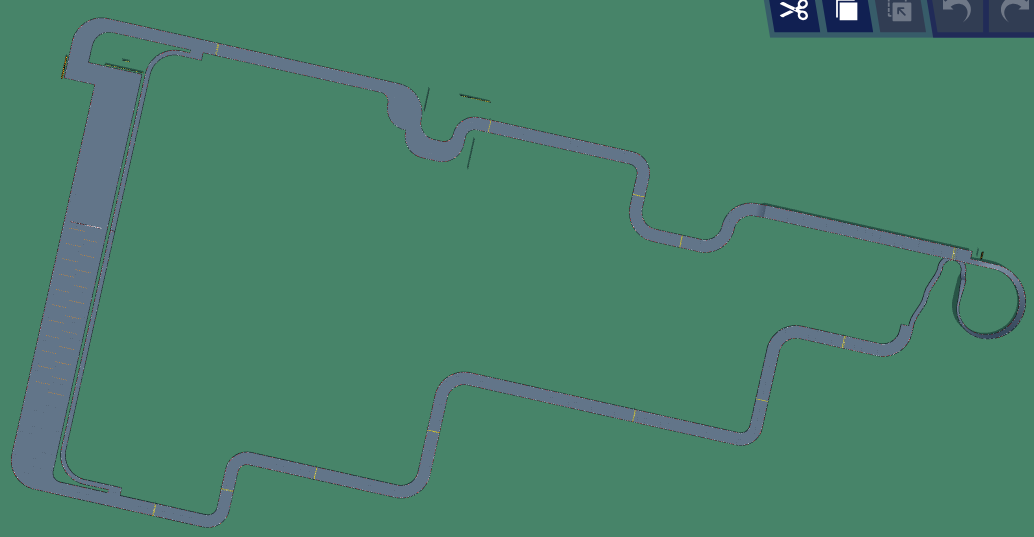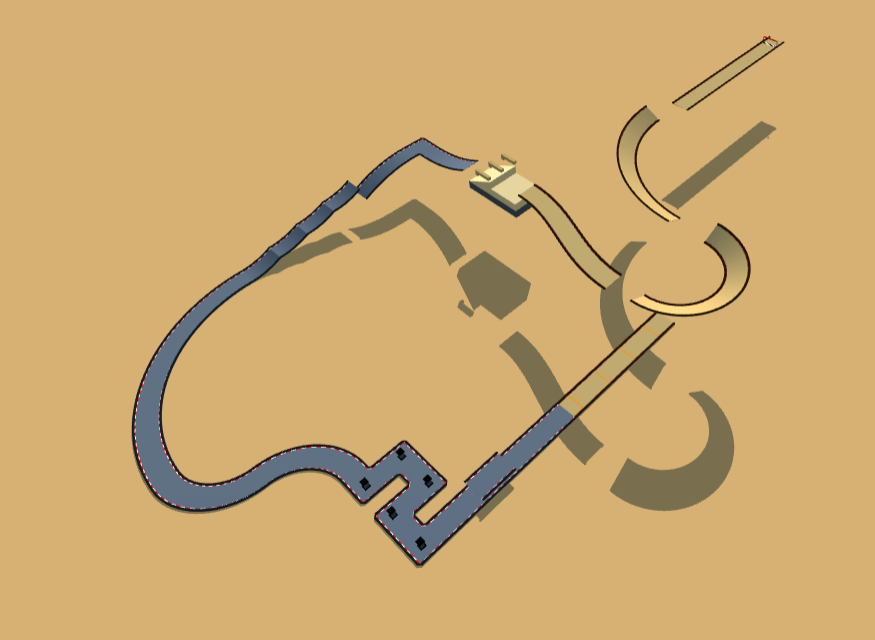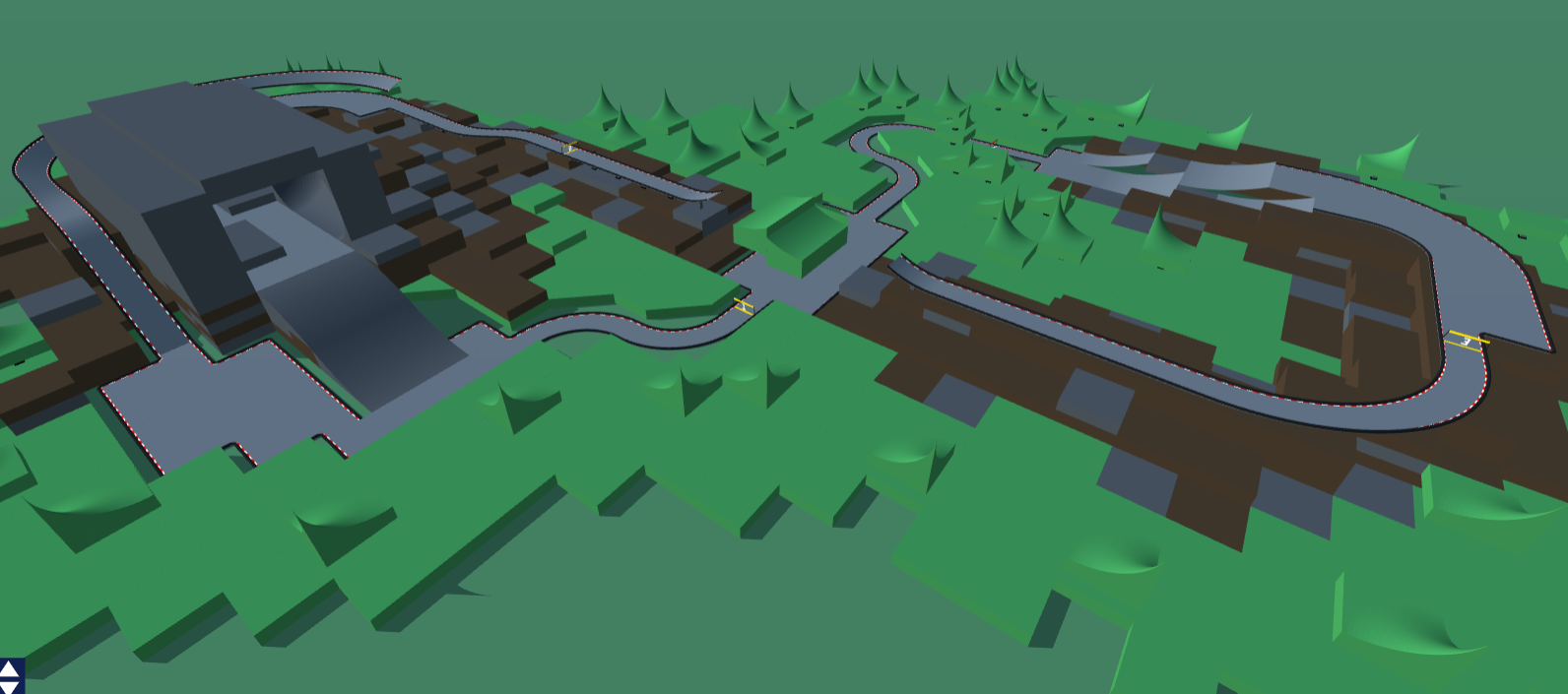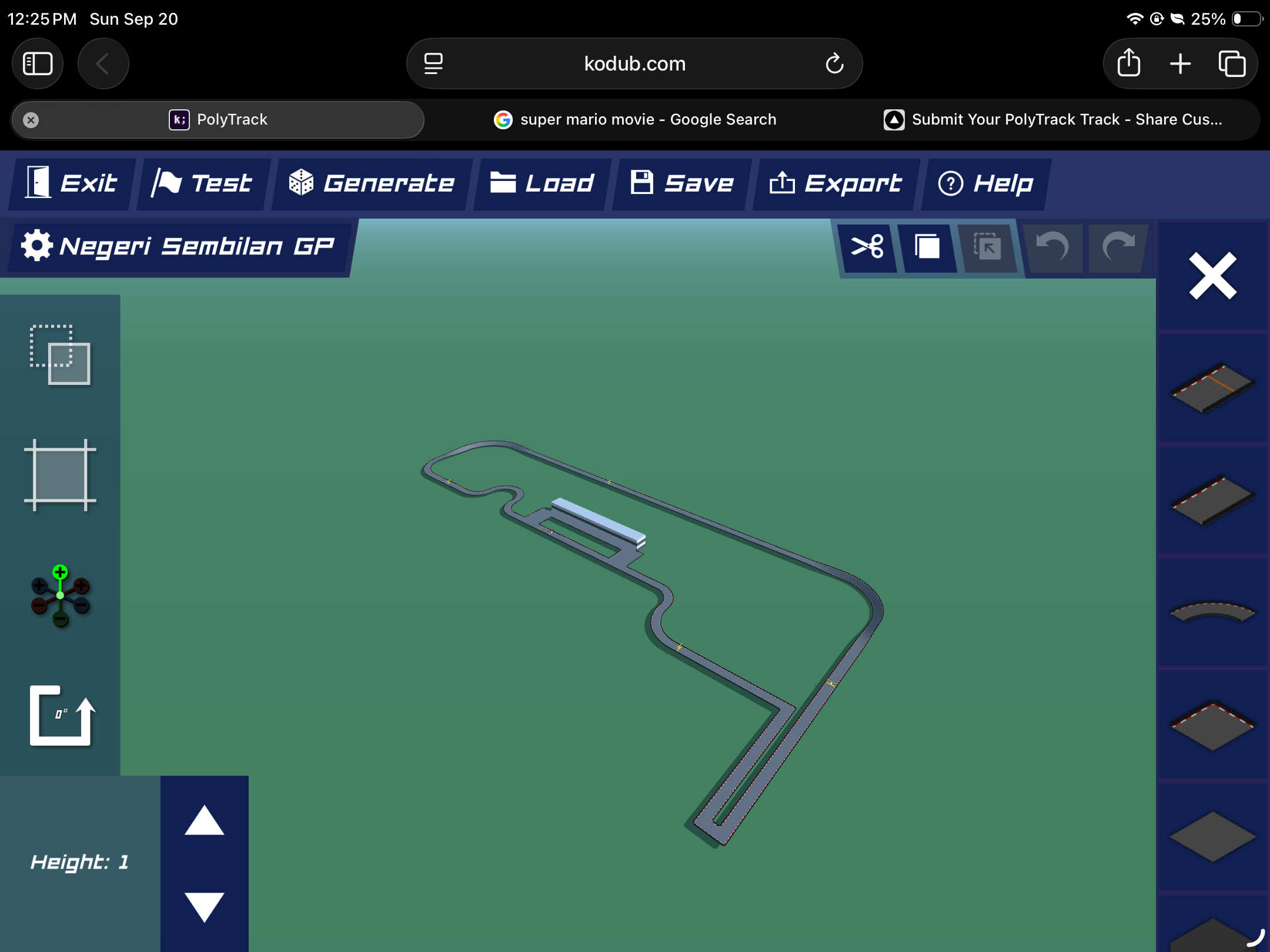
The Vibe (Overview)
Stock car fans, start your engines. u/Straight_Bit_5226 went back to the garage and came out with the Fixed NASCAR Track — a refined, corrected version of a previous NASCAR oval attempt that addresses whatever geometry sins the original committed. The Reddit post title says it all: "Fixed the nascar track" — short, sweet, and dripping with the confidence of someone who knows they nailed it this time.
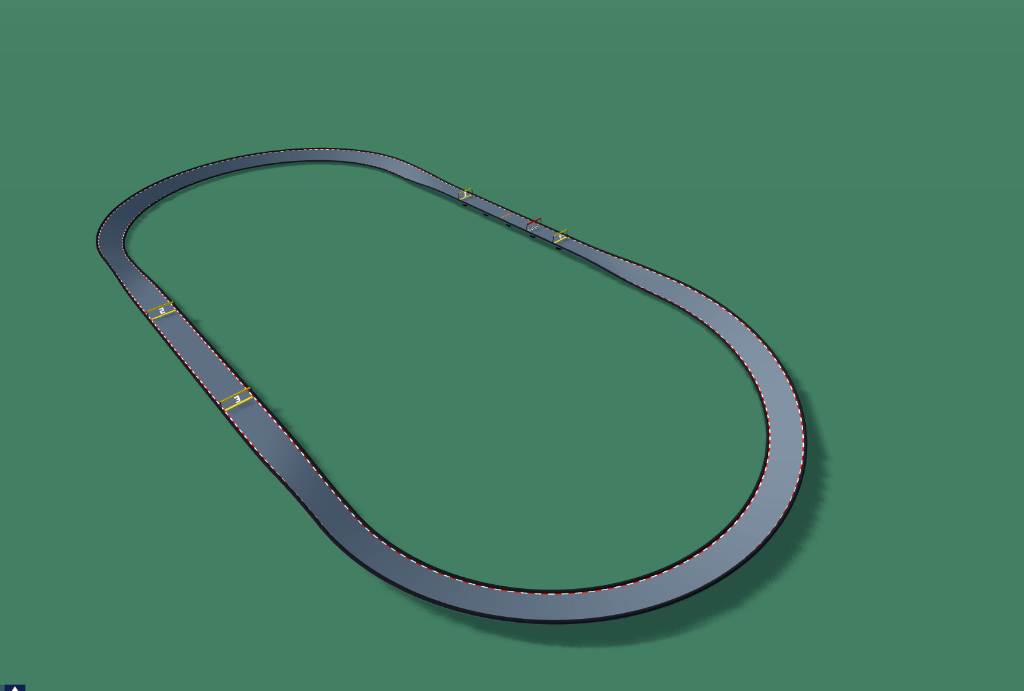
From the overhead screenshot, the layout is unmistakable: a classic elongated oval with two massive banked turns connected by two parallel straights — the quintessential American stock car racing silhouette. The dark grey asphalt is bordered by crisp red racing lines on the inner edge and white dashed lane markers running down the center of the track surface. The whole circuit sits on a clean green surface, casting a subtle shadow beneath it that gives the oval a satisfying sense of depth and presence.
What makes this track special in the PolyTrack context is the sheer commitment to the oval format. Most community tracks are packed with chicanes, elevation changes, and technical wizardry. This one says "no" to all of that. It's pure speed, pure racing line discipline, and pure commitment to the turn. NASCAR ovals look simple until you try to shave tenths off your lap time — then they become the most punishing tracks in motorsport. The geometry is honest, the margins are razor-thin, and the only thing between you and a PB is your ability to hold a consistent line at maximum velocity through both banked turns without lifting.
The Datamine (Nerd Stats)
Cracking open the PolyTrack2 payload:
- Format: PolyTrack2 (Base62 encoded).
- Data Payload: ~298 characters of compressed geometry — a lean, focused build that prioritizes clean oval geometry over structural complexity.
- Layout: Classic elongated oval. Two long straights connected by two sweeping 180-degree banked turns.
- Height: 0 (ground level). Flat oval circuit, true to real-world NASCAR superspeedway design.
- Visual Signature: Dark grey asphalt with red inner racing lines and white dashed center lane markers. Multiple checkpoint gates distributed evenly around the circuit.
- Creator Attribution: u/Straight_Bit_5226 — a fix/iteration on a previous NASCAR build. The "fixed" in the title suggests refined turn geometry and smoother transitions.
The ~298-character payload tells you this is an efficient, purpose-built oval. No wasted blocks on decoration or gimmicks — every piece of geometry serves the racing surface.
Sector Breakdown (Difficulty Analysis)
We're rating this a clean Medium. Don't let the simple oval shape fool you — maintaining maximum speed through continuous banked turns with zero margin for error is a genuine skill test.
- Turn 1 (Upper Left Bank): The first sweeping 180-degree left-hander. The banking helps hold your car into the turn, but the entry speed from the back straight is where most runs die. Enter too hot and you'll scrub the outer wall. Enter too conservative and you've already lost tenths you'll never recover on the straight.
- The Back Straight (Upper Section): The shorter of the two straights, connecting Turn 1's exit to Turn 2's entry. This is your brief window to get the car completely settled before committing to the next bank. Any residual yaw from Turn 1 will compound into Turn 2.
- Turn 2 (Lower Right Bank): The mirror image of Turn 1, but psychologically different. You're carrying speed from a shorter straight, so the entry feels faster. The banked curve sweeps wider here based on the track's egg-shaped oval geometry — commit to the inside line or get walked up the track.
- The Front Straight (Lower Section): The longer main straight with checkpoint gates. This is your speed-building zone and pit wall equivalent. Full throttle, perfectly straight, no excuses. Every km/h you carry out of Turn 2 translates directly into your sector time.
Sweaty Speedrun Strats
- The High Line vs. Low Line Debate: Just like real NASCAR, your racing line through the banked turns determines everything. The low line (inside) is shorter distance but requires you to carry less speed through the apex. The high line (outside) adds distance but lets you maintain higher absolute velocity through the banking. For single-lap time attacks, the high line is generally faster — but only if you can hold it without scrubbing the outer barrier. Find YOUR line and commit.
- Turn Entry Speed Calibration: Each banked turn has a maximum entry speed threshold. Go above it and the physics engine will slide you into the outer wall. Go below it and you're leaving time on the table. Spend your first 10 runs finding this exact speed for both turns — they may differ due to the oval's asymmetric geometry. Lock those numbers into muscle memory.
- Zero Lift Strategy: The ultimate NASCAR oval strat is a full no-lift lap — never releasing the throttle for the entire circuit. This requires finding the exact high line where the banking angle and your speed create equilibrium. If you can pull off a clean no-lift lap, you've mastered the track. Most drivers will need a slight lift entering each turn; the goal is to minimize that lift to the absolute smallest possible throttle reduction.
- Straight-Line Discipline: On the two straights, resist the urge to drift toward the inside or outside. Any lateral movement is energy wasted. Pick a lane, hold it dead straight, and let the car build every possible km/h before the next turn entry. The straights are where lazy drivers lose races to disciplined ones.
Meta Car Choice: The Formula Car is the correct pick for an oval. You need maximum top-end speed for the long straights and high-speed downforce to maintain grip through the banked turns without lifting. The Sport Car lacks the raw speed to be competitive on the straights, and the Rally Car's soft suspension will unsettle the chassis on the constant lateral loading through the banking. Formula Car's rigid chassis and aerodynamic profile are purpose-built for this kind of sustained high-speed cornering.
Track Overview
This medium racing track is a good fit for players interested in racing, community, reddit styles. Use the tags below to find similar layouts or related challenges.
Track codes are community-sourced and may behave differently across game versions. If a code fails to import, try refreshing the game or a different browser before retrying.