The Vibe (Overview)
u/Elecoly_Stuff dropped this one on r/PolyTrack with possibly the most aggressively indifferent title ever: "just try it idc." No pitch, no hype, no begging for upvotes — just raw "here's a track, deal with it" energy. And honestly? That attitude matches the track perfectly, because this build doesn't care about your feelings either.
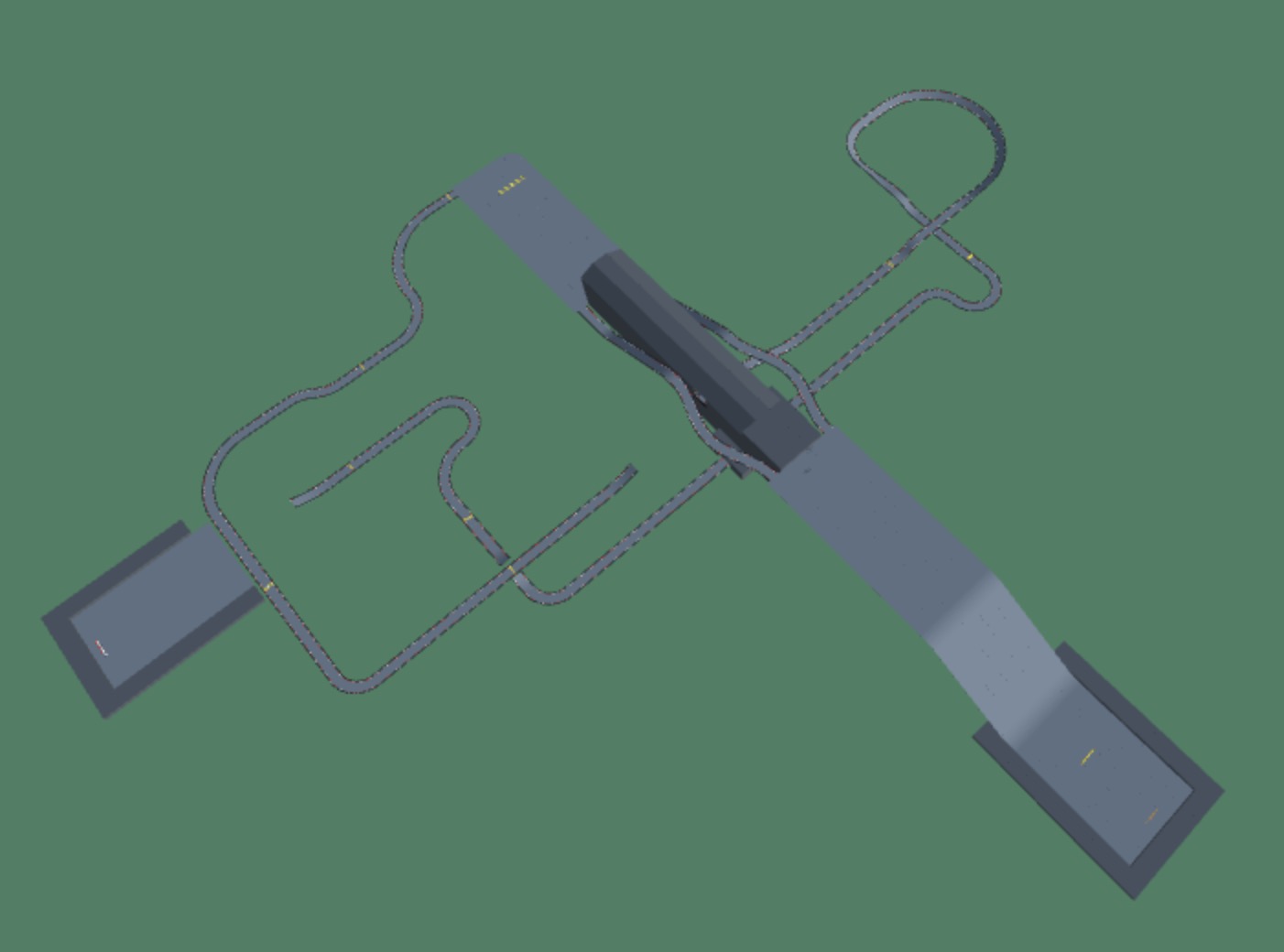
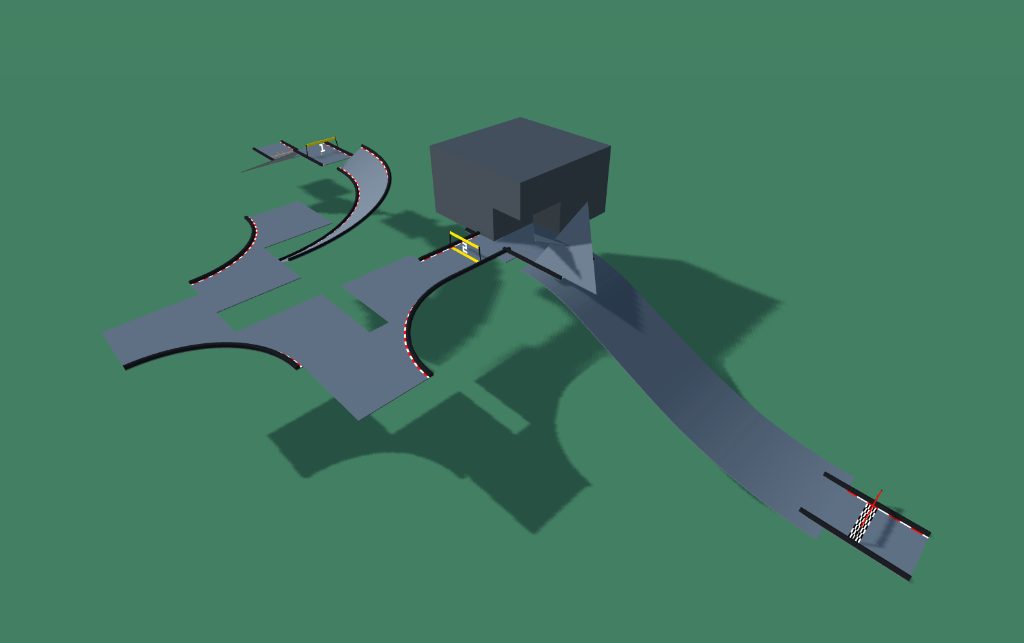
From the screenshot, the layout is immediately dominated by a massive dark cube structure sitting dead-center — a monolithic block of grey geometry that towers over everything else on the map. To its left, a series of curved road sections with red-and-white curbing snake through a network of flat grey platform intersections, creating a technical approach corridor. Two yellow checkpoint gates are visible — one near the top of the approach and one at the base of the cube — confirming this is a point-to-point run, not a circuit. On the right side, a long grey ramp descends from the cube structure all the way down to the finish line, marked by a checkered flag at the far end.
The whole design philosophy screams "figure it out yourself." The cube isn't decoration — it's the core obstacle. You approach from the left through tight curves, somehow interact with or navigate around this brutalist block, then commit to the long descending ramp to the finish. The track's nonchalant title belies what is actually a tricky routing puzzle disguised as a simple stunt run.
The Datamine (Nerd Stats)
Cracking open the PolyTrack2 payload:
- Format: PolyTrack2 (Base62 encoded).
- Data Payload: ~340 characters of compressed geometry — a moderately compact build that focuses structural density on the central cube element.
- Architecture: Three distinct zones — a curved approach corridor (left), a towering cube obstacle (center), and a long descending finish ramp (right).
- Height: Significant vertical presence from the cube structure. The ramp descent covers substantial vertical drop from cube height down to ground level.
- Visual Signature: Clean grey platforms and road surfaces with red-white curbing on the curves. The cube is solid dark grey, casting a prominent shadow. Minimalist color palette — the track lets its geometry do the talking.
- Creator Attribution: u/Elecoly_Stuff — delivering maximum indifference with their Reddit debut.
The ~340-character payload is deceptively efficient. The cube structure alone absorbs a significant portion of the geometry budget, meaning the driving surfaces are built with ruthless economy — every curve and ramp piece is load-bearing.
Sector Breakdown (Difficulty Analysis)
This earns a solid Hard rating. The combination of tight technical curves, a cube-based routing puzzle, and a high-speed ramp descent creates a three-phase challenge that tests different skills in each sector.
- The Curved Approach: The left-side road network features multiple sweeping curves bordered by red-white curbing. The intersecting platform geometry creates visual noise that makes it easy to misjudge your line. The curves tighten progressively as you approach the cube, demanding decreasing speed at the exact moment your instincts want to accelerate.
- The Cube Encounter: The central cube is the track's signature skill check. Whether you're launching off a ramp onto its surface, threading a gap beside it, or using it as a wall-ride element, the interaction with this massive geometric block requires a very specific approach vector and speed. Get it wrong and you're either slamming into a flat wall or sailing past the transition point into empty space.
- The Descent Ramp: The long grey ramp extending from the cube down to the checkered finish is your final sector. It looks like free speed — and it is, if you can maintain control. The ramp's angle accelerates you rapidly, and any lateral instability from the cube transition gets amplified exponentially as you pick up speed. By the time you reach the finish gate, you're moving fast enough that even a minor steering correction becomes a potential spinout.
Sweaty Speedrun Strats
- Curve Entry Discipline: On the approach curves, brake earlier than feels natural. The red-white curbing is solid collision geometry — clipping it doesn't just cost you time, it deflects your car's trajectory and ruins the angle for the next curve. Build a rhythm through the approach: brake, turn, accelerate. Brake, turn, accelerate. No shortcuts.
- Cube Commitment: Whatever the correct interaction with the cube structure is — ramp launch, wall ride, gap threading — you need to commit fully before you reach it. Mid-approach steering corrections near the cube face will put you into the wall at speed. Find the line in practice, memorize the entry point, and execute without deviation.
- Ramp Speed Control: On the descent ramp, resist the urge to go full throttle immediately. The initial portion of the ramp is where you set your alignment for the entire descent. Get the car perfectly centered and arrow-straight in the first third of the ramp, then floor it. A perfectly aligned descent is faster than a crooked one at higher speed — the physics of the finish gate crossing rewards a clean, straight approach.
- Checkpoint Routing: With two visible checkpoint gates, the routing between them determines your total path length. The shortest physical distance between checkpoints might not be the fastest — sometimes a wider approach angle lets you carry more speed through the transition. Map both checkpoints and find the line that minimizes total time, not total distance.
Meta Car Choice: The Sport Car gets the nod here. The curved approach demands responsive steering, the cube interaction needs predictable chassis behavior, and the ramp descent rewards a car that stays stable at high speed. The Rally Car's soft suspension would bounce on the ramp's surface transitions, and the Formula Car's wide body is a liability in the tight approach curves. Sport Car gives you precision where it counts and stability where it matters.
Track Overview
This hard stunt track is a good fit for players interested in stunt, technical, community styles. Use the tags below to find similar layouts or related challenges.
Track codes are community-sourced and may behave differently across game versions. If a code fails to import, try refreshing the game or a different browser before retrying.