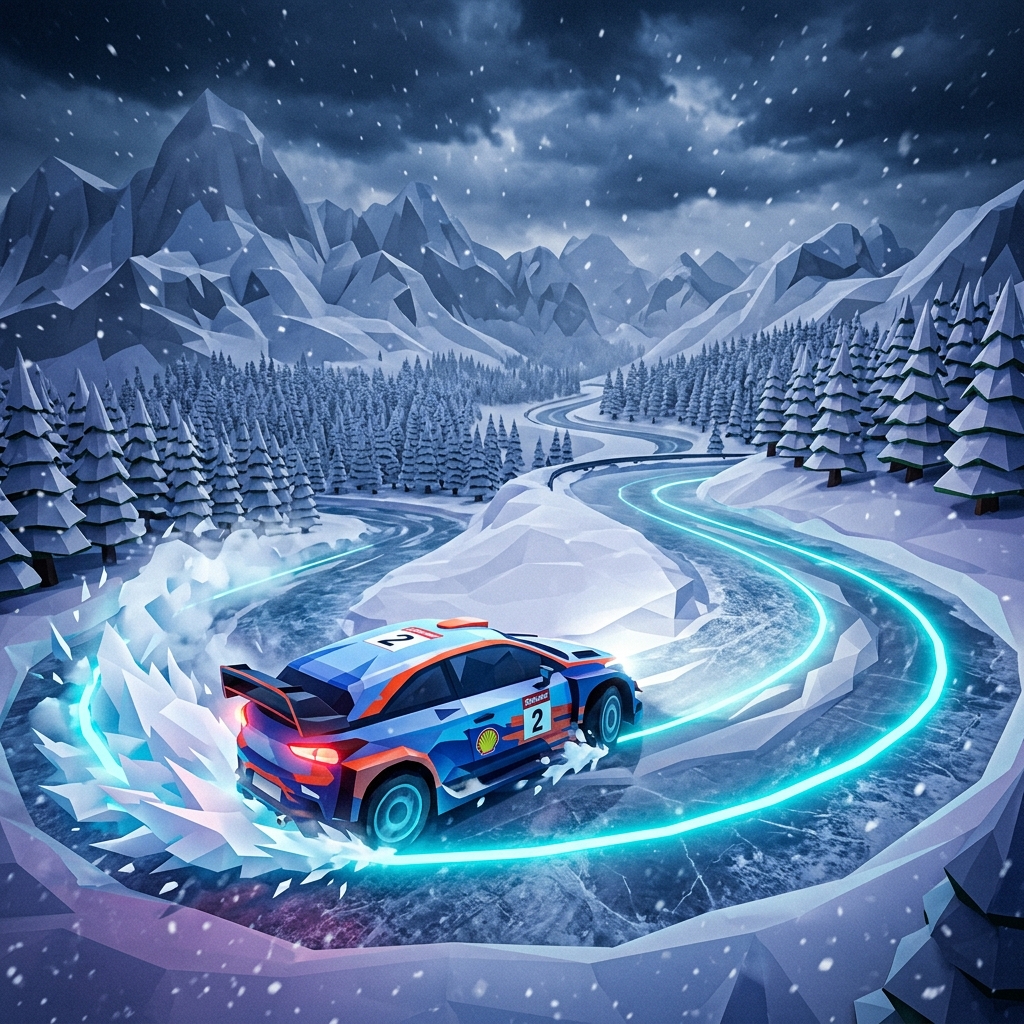
PolyTrack Winter 2 Speedrun Guide: Mastering the Frozen Flow
Winter 1 teaches you that ice exists. Winter 2 teaches you to love it.
This track takes the ice physics you learned and wraps them around a longer, more complex layout with extended sliding sections, grip transitions, and jumps where the landing surface punishes every degree of imperfect pitch. It's the track where "I can handle ice" either becomes a genuine skill or a comfortable lie.
| Property | Detail |
|---|
| Environment | Winter (heavy snow, extensive ice coverage) |
| Estimated Length | ~350 meters |
| Checkpoints | 4-5 |
| Key Features | Extended ice straights, grip transitions, multiple technical corners, 1-2 jump sections |
| Difficulty | Medium-Hard |
| WR Reference | ~14-18 seconds |
Winter 2 is notably longer than Winter 1 and introduces surface transitions—sections where the road shifts between ice and regular tarmac. These transitions are where most competitive time is won or lost, because your driving style must change within the space of a few meters.
Sector 1: Extended Ice Straight and Opening Turn
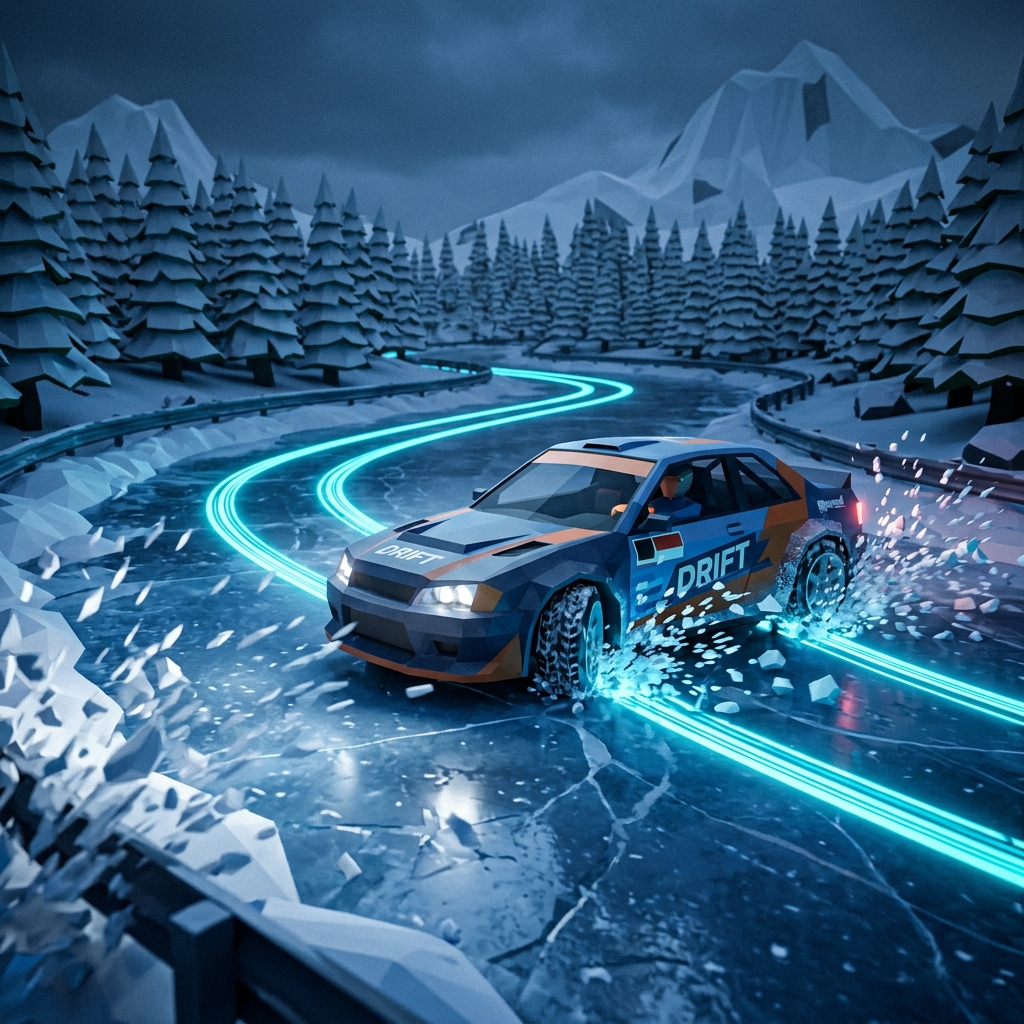
Winter 2 often opens with a longer straight that gives you time to build speed on ice—which sounds harmless until you realize the first turn arrives while you're at maximum velocity on a surface with minimal grip.
The challenge: High-speed cornering on pure ice. This is fundamentally different from the moderate-speed ice corners of Winter 1.
Technique:
- Begin braking earlier than feels natural. On ice at full speed, braking distance can be 3-4x longer than Summer.
- Don't try to turn and brake simultaneously on ice. Brake in a straight line first, THEN steer. Combining braking with steering on ice causes immediate loss of control.
- Accept a wider line through the first turn. Trying to hit a tight apex while decelerating on ice is a recipe for wall contact.
The brake-then-steer rule: This is possibly the most important technique for Winter tracks at competitive speeds. On Summer, you can brake and steer simultaneously. On ice, you cannot. Separate these inputs.
Sector 2: The Grip Transition Zone
At some point in Winter 2, the road surface changes—from full ice to partial grip or even regular tarmac, then potentially back to ice.
Why this matters: Your entire driving approach needs to change in an instant. The steering sensitivity, braking distance, and drift behavior are different on each surface. If you're using ice technique on tarmac, you're leaving speed on the table. If you're using tarmac technique on ice, you're crashing.
How to read the surface:
- Visual cues: ice is shinier, tarmac is darker and more textured.
- Feel: the car responds to steering faster on tarmac; it feels "heavier" and more planted.
Transition technique:
- When entering tarmac from ice: you can immediately steer more aggressively and brake later.
- When entering ice from tarmac: pre-adjust 2-3 car lengths before the transition. Start braking earlier and reduce steering input.
Sector 3: The Technical Corner Sequence
Winter 2's middle section typically features 2-3 connected corners on varying surfaces. This is the competitive heart of the track.
Strategy: Map each corner's surface type from practice runs:
- Corner on tarmac → standard racing line, moderate speed
- Corner on ice → wide entry, gentle steering, throttle feathering
- Transition corner (starts tarmac, ends ice) → aggressive entry, gentle exit
The sequence rewards memorization. Once you know which surface each corner sits on, you can pre-select the correct technique before you arrive.
Sector 4: The Winter Jump Section
Winter 2's jump combines the challenges of air control with the hazard of landing on ice.
The critical difference from Summer jumps: After landing, you cannot steer or brake immediately. Ice provides minimal grip right after touchdown, and any input causes sliding.
Approach:
- Match pitch to landing angle as precisely as possible—there's zero margin for error on ice.
- Land with the car pointed exactly where you want to go. On Summer, you can adjust direction after landing. On ice, your landing direction IS your direction for the next 0.5-1 second.
- Keep all inputs neutral for a moment after landing. Let the car establish grip before doing anything.
1. The Straight-Line Brake
The foundation of high-speed ice driving. Before every major turn:
- Release all steering input (car goes straight).
- Tap or hold S (brake) to reduce speed.
- Once at cornering speed, release brake.
- THEN begin steering into the turn.
This three-step process (straight → brake → steer) feels slow at first but is dramatically faster than trying to brake and steer simultaneously on ice.
2. Surface Memory Mapping
After 3-4 practice runs, you should be able to describe the surface type of every section from memory. Build a mental map: "Straight 1: ice. Turn 1: ice. Transition to tarmac. Turn 2: tarmac. Jump: tarmac takeoff, ice landing."
This mental map lets you pre-adjust your technique before each section, eliminating reaction time entirely.
3. Controlled Ice Sliding
At advanced levels, ice sliding becomes a tool rather than a problem. Some corners on Winter 2 are actually faster when you deliberately initiate a controlled slide rather than trying to grip-steer through them.
The principle: A controlled slide maintains speed while rotating the car. Grip-steering on ice requires slowing down first. If you can control the slide angle, sliding is faster.
Warning: This technique is high-risk, high-reward. Master the basics first.
| Mistake | Why It Happens | Fix |
|---|
| Brake-steer combo on ice | Summer habits persisting | Separate: brake straight, then steer. Always. |
| Not reading surface transitions | Focusing on the road ahead, not the road under you | Learn the surface map; pre-adjust before transitions |
| Aggressive steering on ice | Overcompensating for wide turns | Gentler inputs produce tighter turns on ice |
| Immediate steering after landing | Muscle memory from Summer jumps | Wait 0.3-0.5s post-landing, then steer gently |
| Level | Target Time | What It Means |
|---|
| 🟢 First Completion | 40-55 seconds | You survived the extended ice layout |
| 🟡 Beginner | 28-40 seconds | Brake-then-steer is becoming habitual |
| 🟠 Intermediate | 20-28 seconds | Surface transitions handled smoothly |
| 🔴 Advanced | 15-20 seconds | Deliberate ice sliding in key corners |
| 🏆 World Record Tier | <15 seconds | Every surface, every corner, every landing optimized |
Drill 1: Brake-Then-Steer
Pick the fastest ice corner on Winter 2. Do 20 runs focusing exclusively on separating your brake and steer inputs. You'll feel the difference in car behavior within 5 runs.
Drill 2: Surface Transition Awareness
Do 3 slow laps. On each lap, verbally call out the surface type as you drive over it: "Ice... ice... tarmac now... corner on tarmac... transitioning to ice..." This builds conscious awareness of what's under your tires.
Drill 3: Controlled Slide Practice
Find a wide ice corner. Instead of grip-steering through it, deliberately initiate a slide with Spacebar and try to hold the car at a consistent drift angle through the entire turn. Don't worry about speed—focus on control.
I cleared Winter 1 — why is Winter 2 so much harder?
Two reasons: it's longer, and it constantly changes the surface under you. Winter 2 strings together ice straights, grip transitions, and technical corners, so a single lap demands you re-adjust your braking and steering several times. Consistency across the whole layout matters more than any one fast corner.
Why do I lose the car when braking into an icy turn?
You're braking and steering at the same time. On ice that combination overwhelms the tires instantly. Separate them: brake in a straight line first, release, then steer. The brake-then-steer drill above fixes this faster than anything else.
How do I stop getting caught out by surface changes?
Learn the surface map and pre-adjust before each transition rather than reacting after it. The "call out the surface" slow-lap drill builds this awareness — once you know a patch of ice is coming, you can lift off early instead of scrambling mid-corner.
Is deliberately sliding ever faster than gripping here?
Yes, on the wide ice corners. A controlled slide (initiate with Spacebar and hold a steady drift angle) can carry more speed through a sweeping turn than trying to grip it. Practice holding the angle for control first; chase speed once the slide feels repeatable.
Where should I focus to drop the most time?
The grip transitions and the landing after each jump. A clean, flat landing on ice followed by a patient ~0.4-second pause before steering preserves the speed you fought to build on the straights.