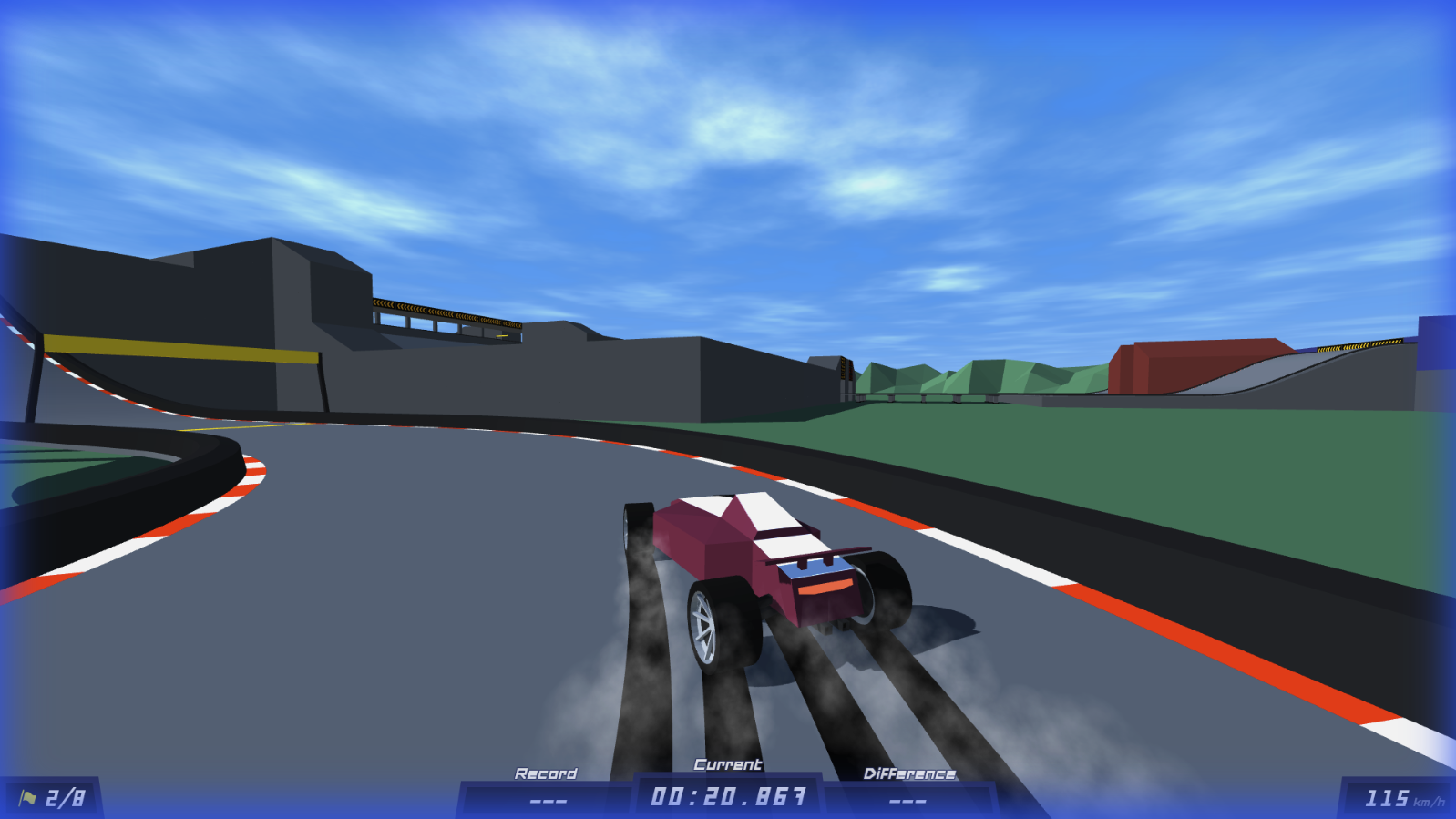
Fast players do not only restart faster
PolyTrack looks like a restart game, but strong players are not simply smashing restart more often. They know what each attempt is testing. That is the difference between practicing and looping the same mistake for an hour.
Use this four-pass routine when you want to improve a track seriously.
Pass 1: the sighting run
The first run is not about time. Drive at 70 percent speed and learn the route. Name the main sections out loud or in your head: opener, first jump, long turn, wall ride, finish. If you cannot name the sections, you cannot practice them.
End the sighting run with one sentence: "This track is mainly about..."
Examples:
- "This track is mainly about landing straight."
- "This track is mainly about carrying speed through two long turns."
- "This track is mainly about not oversteering after the checkpoint."
Pass 2: the sector run
Pick one sector and ignore the rest. A good sector target is small enough to repeat quickly: the first ramp, the first S-curve, the landing after a drop, or the last turn before the finish.
Do five attempts where you only judge that sector. If you improve the sector but crash later, count it as a useful attempt. This keeps you from measuring everything by finish time too early.
Pass 3: the ghost run
Ghosts and leaderboard runs are powerful because they show where time is actually lost. The lesson is not "copy the fastest player perfectly." The lesson is "find the first place where your car is already slower."
Watch for:
- Earlier braking, not later braking.
- Straighter landings after jumps.
- Wider setup before a tight corner.
- Less steering movement on long curves.
- Faster recovery after a checkpoint.
If a ghost is much faster than you, compare only the first 10 seconds. Once that section improves, compare the next 10.
Pass 4: the pressure run
After practice, do three complete runs only. No endless restart loop. The goal is to prove the improvement can survive a full lap. If you make a mistake, keep driving unless the run is completely dead. This teaches recovery, which matters on longer community tracks.
Record your best clean run, not only your fastest messy run. A clean run is easier to improve next time.
A simple 30-minute session
| Minute | Task |
|---|
| 0-5 | Sighting runs and route notes |
| 5-15 | Sector practice |
| 15-22 | Ghost or leaderboard comparison |
| 22-27 | Three complete pressure runs |
| 27-30 | Write one thing to practice next time |
What to avoid
Do not switch tracks after every bad run. Do not chase the world record before you can finish cleanly. Do not blame the car setup before you have a repeatable line.
The best PolyTrack practice feels narrow. One section, one mistake, one fix. Then the whole lap gets faster.
Sources checked