Fair does not mean easy
Some of the best PolyTrack maps are hard. The difference is that fair hard tracks make players believe the next attempt will be better. Unfair tracks make players feel like the designer is hiding information.
A fair track gives the player three things: a readable goal, a clear mistake, and a reason to retry.
Readability comes first
Players should understand what the section wants before they fail it. They do not need to succeed immediately, but they should know whether the challenge is speed, angle, braking, landing, or timing.
Bad difficulty says: "Guess what the map wants."
Good difficulty says: "You know what to do. Now do it cleaner."
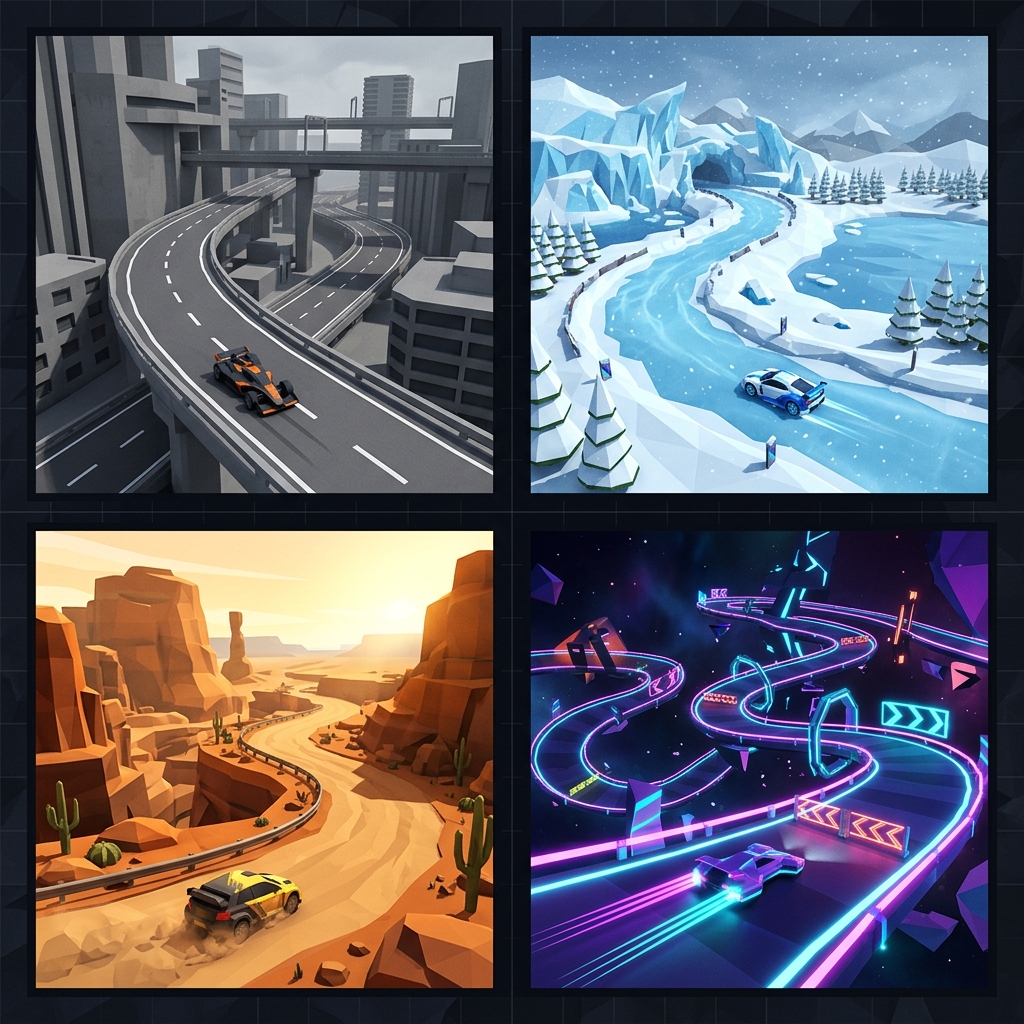
Use color, shape, road width, and checkpoint direction to teach the route. A narrow road after a wide road tells the player to prepare. A straight before a ramp tells the player to line up. A visible landing tells the player the jump is intentional.
Reset rhythm matters
PolyTrack works because retries are fast. If a player fails in three seconds and understands why, they will try again. If a player drives 50 seconds before reaching the real obstacle, every failure feels expensive.
For hard sections, put the practice loop close to the start or after a checkpoint. For long scenic tracks, make the early sections easier and save the hardest idea for a place where players have already learned the route.
Checkpoints should teach
A checkpoint is not only a save point. It is a message. It tells the player where the designer thinks the next meaningful section begins.
Good checkpoint placement:
- Faces the next direction of travel.
- Gives enough room to regain control.
- Avoids respawning the car at a strange angle.
- Does not skip the skill the track is trying to teach.
If a checkpoint respawn is harder than the original approach, move it.
Landing zones are part of the jump
Creators often spend too much time on takeoff and not enough on landing. A jump is only fun when the landing can be read and corrected. Give the player a landing surface that rewards angle discipline, then give them a short recovery space before the next major input.
If the player lands and immediately hits a blind wall, the failure feels cheap. If the player lands crooked and loses speed, the failure feels earned.
Difficulty should rise in steps
A fair track escalates. It introduces the idea safely, then asks for a cleaner version, then asks for the hard version. This is why a simple early jump can make a later hard jump feel better: the player has already learned the language.
The best community tracks feel like a conversation between creator and driver. The creator sets a problem. The player learns the answer. The next section asks for a stronger answer.
Creator checklist
Before publishing, ask:
- Can a first-time player read the route?
- Is every failure understandable?
- Is the hardest section close enough to a reset point?
- Does the track reward skill more than memorization?
- Would the track still be fun if the player never gets a leaderboard time?
If yes, the track is not just hard. It is worth playing.