PolyTrack vs TrackMania: The Deep Dive 2025 comparison
The "arcade racer with a track editor" genre has two reigning monarchs in 2025. In the red corner, the heavyweight champion with a 20-year legacy: Trackmania. In the blue corner, the agile, browser-based challenger that has taken schools and offices by storm: PolyTrack.
Superficially, they look similar. You drive a car, you beat the clock, you build tracks. But dig 1% deeper, and you find they are philosophically opposite explanations of what a racing game can be. One is a maximalist simulation of physics and competition; the other is a minimalist distillment of "flow."
This 3000-word guide rips apart the engines, the communities, and the code to help you understand which one deserves your hours.
Part 1: The Physics Engine Under the Hood
The soul of any racing game is its physics engine. It's the invisible hand that decides if a jump feels heroic or floaty.
Trackmania: The Science of Grip
Trackmania (specifically the 2020 release) runs on a proprietary engine refined over two decades. It is deterministic—meaning the same inputs will always result in the same outcome, down to the coordinate. This determinism is the bedrock of its competitive scene.
But the physics are notoriously complex. The game features four distinct "environments" (Stadium, Desert, Rally, Snow), each with unique handling models.
- Stadium Car: High downforce, incredible grip. The "standard" F1-style racer.
- Surface Complexity: The engine calculates friction differently for Asphalt, Dirt, Grass, Plastic, and Ice.
- The "Tech" List:
- Speed Drift (SD): On asphalt, overlapping your skid marks by ~50% at high speeds (>400 speed) generates extra acceleration. It's counter-intuitive but essential for high-level play.
- Neo-Slide: A rapid steering input used to initiate a drift at low speeds or on varying surfaces where a normal brake-drift wouldn't work.
- Bug Slide: Landing a car at a 90-degree angle to slide instantly, scrubbing zero speed while changing direction.
- Ice Physics: A genre unto itself. Ice racing (bobsleigh style) requires "reactor boost" management and precise steering angles to maintain momentum without traction.
Mastering Trackmania isn't just about driving lines; it's about learning a hidden language of physics exploits that have become features.
PolyTrack: The Momentum of Minimalism
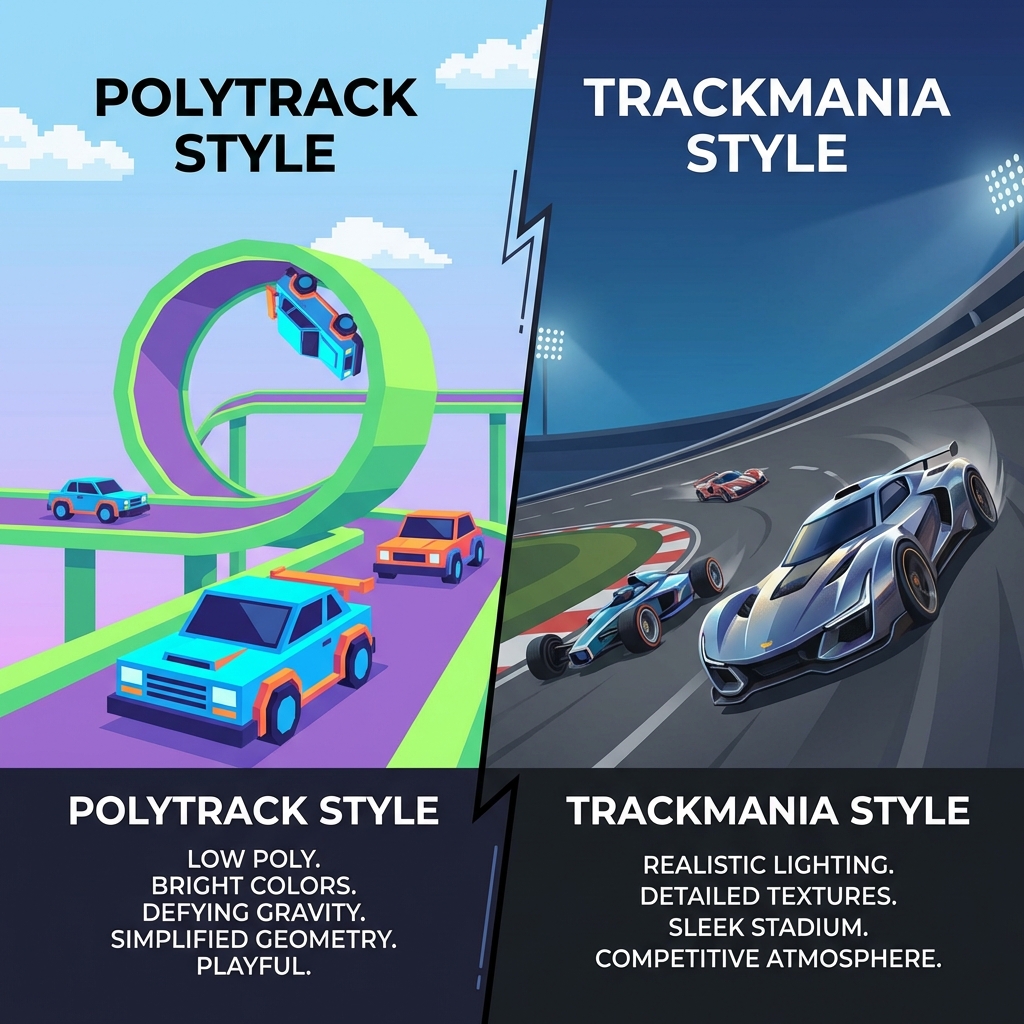
PolyTrack's physics are lighter, floatier, and more forgiving. Built for the browser (WebGL), it doesn't utilize the heavy ray-casting or complex surface friction calculations of TrackMania.
- Uniform Traction: Unlike TM, PolyTrack doesn't punish you severely for touching "off-road" surfaces. The penalty is speed reduction, not a total loss of car control.
- Air Control: While TM allows for some air-braking rotation, PolyTrack gives you significant influence over your car's pitch and yaw in mid-air. This allows for "save" mechanics where you can correct a bad jump before landing.
- Hitbox Consistency: The low-poly aesthetic isn't just specific; it's functional. The car's hitbox is a simple geometric shape. This leads to fewer "ghost collisions" (hitting an invisible wall) compared to complex mesh-based racers.
- The "Flow" State: PolyTrack physics favor momentum. Drifts don't scrub as much speed as they realistically should. This creates a gameplay loop that feels closer to Tony Hawk's Pro Skater than Forza. You are encouraged to chain features together rather than dissect them for milliseconds.
Winner:
- For Depth: Trackmania. The skill ceiling is essentially infinite.
- For Feel: PolyTrack. It hits the "fun" dopamine button immediately.
Part 2: The Art of Track Creation
If physics is the soul, the Editor is the heart. Both games live and die by User Generated Content (UGC).

PolyTrack: The "Lego" Approach
PolyTrack's editor is a triumph of UI design. It feels less like CAD software and more like a toy box.
- Grid-Based Snap: Everything locks to a logical grid. You rarely wrestle with alignment errors.
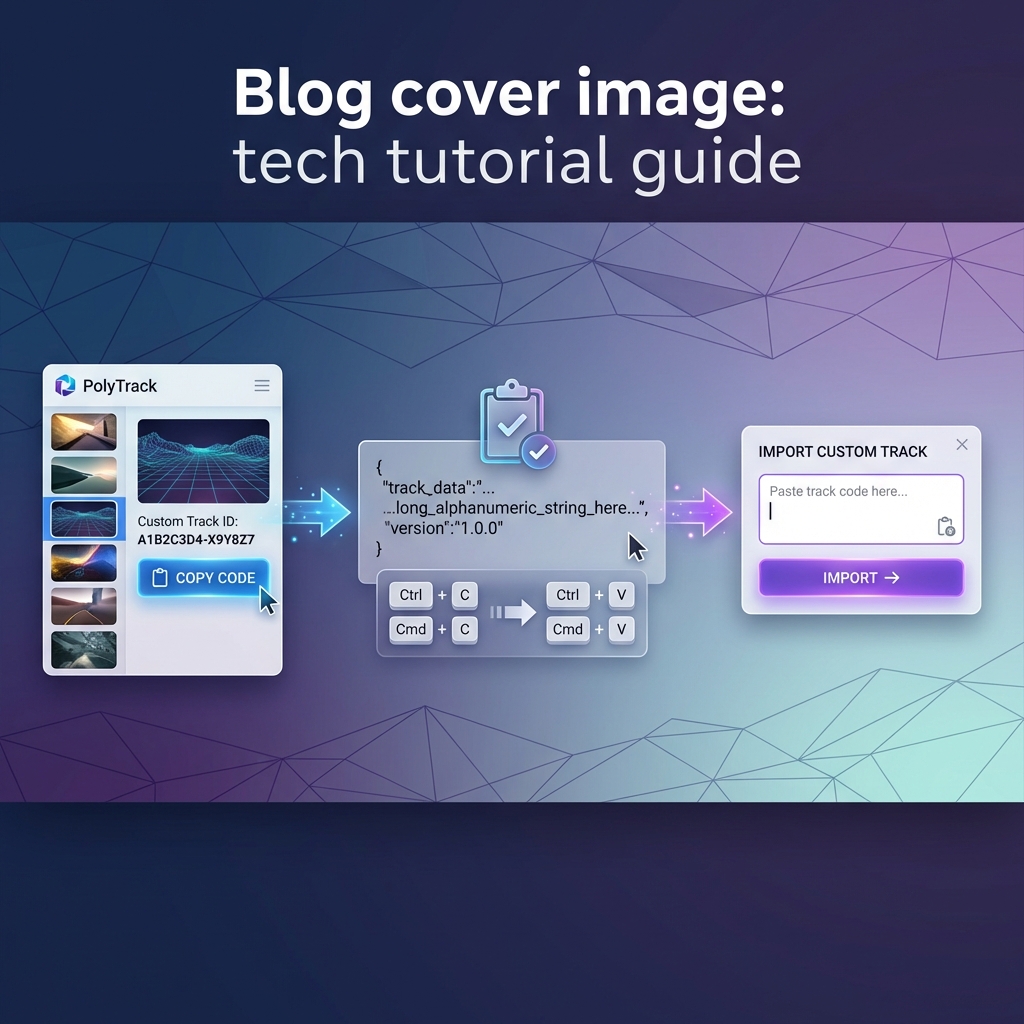
- Export-to-Code: This is PolyTrack's killer feature. A track isn't a 50MB file; it's a string of text. You can copy a track code, paste it into Discord, or tweet it. This friction-less sharing mechanism is why PolyTrack went viral.
- Browser Memory: Because it runs in a browser tab, your limits are defined by your RAM. You can build massive tracks, but eventually, Chrome will choke. There's no hard "block limit," but there is a performance horizon.
- Immediate Iteration: The time between "placing a ramp" and "testing the ramp" is milliseconds. There is no loading screen. This encourages a "build-test-build" loop that is incredibly addictive.
Trackmania: The "Architect" Approach
The Trackmania editor is professional-grade software. In "Advanced Mode," it is daunting.
- MediaTracker: You aren't just building a track; you're directing a movie. You can trigger camera cuts, colour grading changes, custom text overlays, and GPS replays.
- The Shader/Shadow Calculation: When you finish a map in TM, you must calculate "shadows." This builds a "lightmap" for your level. High-quality shadow calculation can take hours on older PCs. This step is mandatory for a map to look "finished."
- Mesh Modeler: You can import custom 3D models (Blender files) into the game. High-level TM maps often look like completely different games because creators have replaced every single asset.
- NadeoImporter: For the elite, you can bypass the editor entirely and script map generation.
Winner:
- For Pure Creativity: PolyTrack. The constraints breed creativity, and the instant sharing is unbeaten.
- For Professional Design: Trackmania. If you want to build a portfolio piece, this is your tool.