From a solo developer's vision to a global phenomenon: The story of PolyTrack's meteoric rise
It's 12:30 PM on a Tuesday at a high school in suburban Chicago. In the computer lab, instead of research papers and math assignments, dozens of screens glow with the unmistakable low-poly aesthetic of PolyTrack. Students huddle around computers, cheering as cars backflip through impossible loops, sharing track codes scribbled on notebook paper, and competing for the fastest times. This scene repeats itself in thousands of schools across dozens of countries, every single day. But how did a simple browser game create such a worldwide movement?
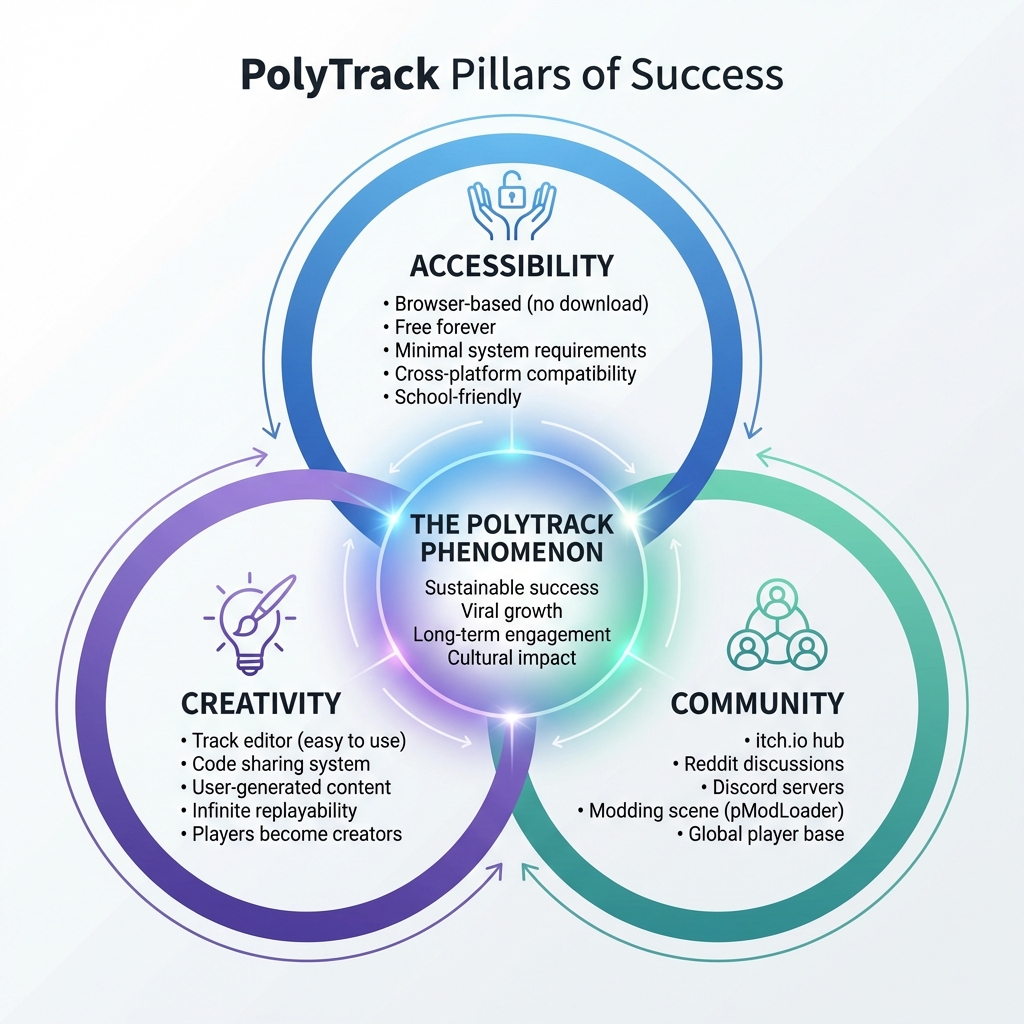
The answer lies in a perfect storm of accessibility, creativity, and community—three elements that transformed PolyTrack from an indie project on itch.io into a cultural phenomenon that rivals games with hundred-million-dollar budgets. This is the story of how one developer's bet on browser-based gaming paid off in ways nobody could have predicted, and why PolyTrack's influence extends far beyond the world of racing games.
Chapter 1: The Genesis of PolyTrack
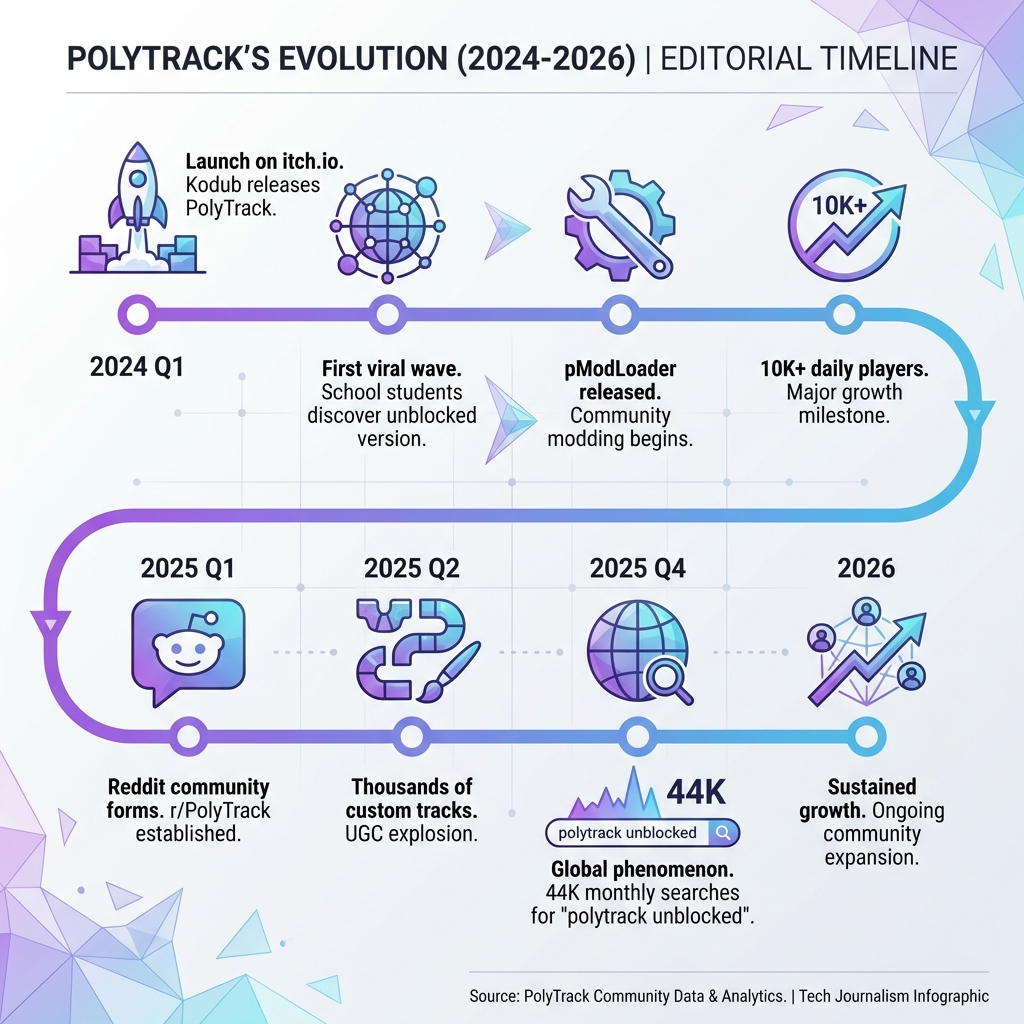
In 2024, while AAA game studios were pouring resources into cutting-edge graphics and complex monetization schemes, a developer known as Kodub took a radically different approach. PolyTrack emerged from a simple yet revolutionary idea: what if a racing game required absolutely nothing from players except a web browser?
Kodub's philosophy was refreshingly straightforward—no downloads, no installations, no account creation, no barriers whatsoever. Just open a browser, load the page, and start racing. This decision would prove to be the foundation of PolyTrack's explosive growth.
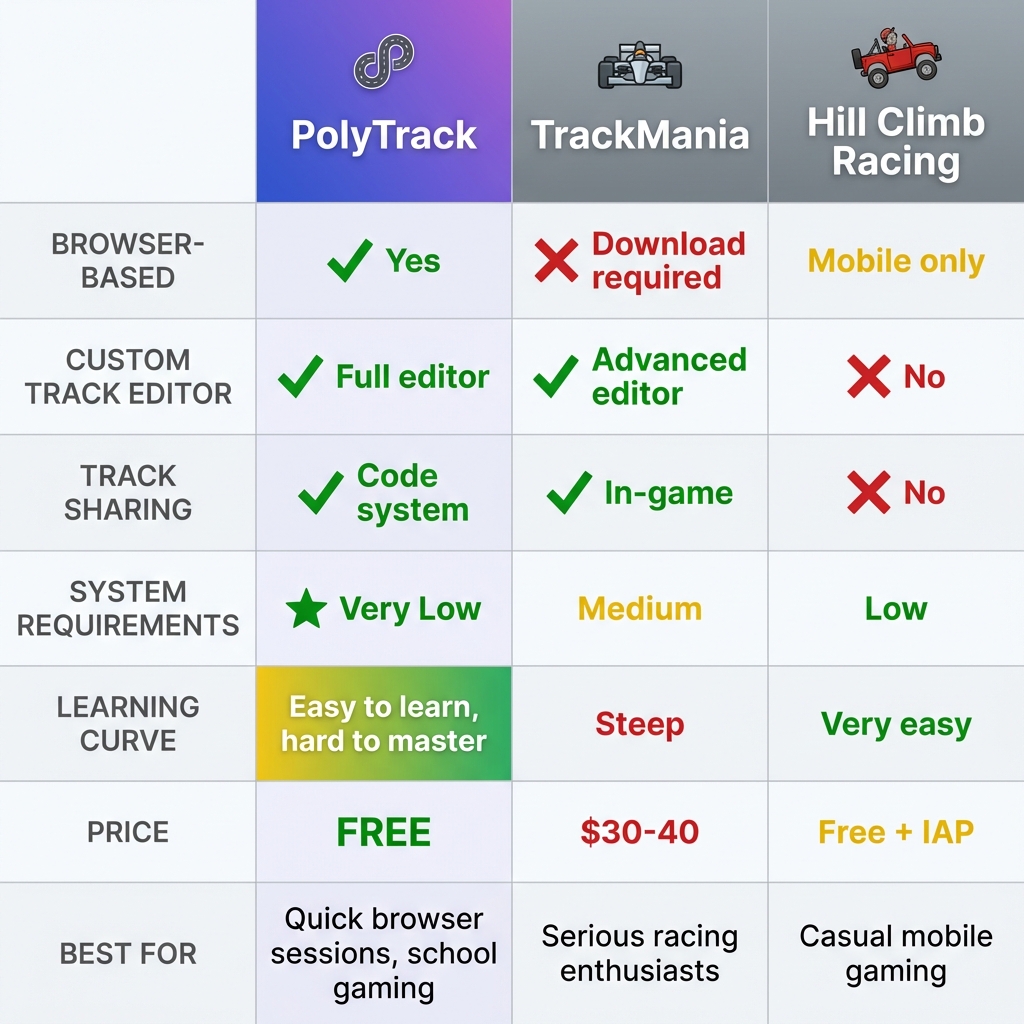
The choice of low-poly graphics wasn't just an aesthetic preference; it was a strategic masterstroke. By embracing minimalist 3D design with flat-shaded polygons and simple geometries, PolyTrack could run smoothly on virtually any computer made in the last decade. That aging laptop in the school library? It runs PolyTrack perfectly. The budget Chromebook issued by your school district? No problem. This universal compatibility meant that PolyTrack could reach players that high-end racing games like Forza or Gran Turismo simply couldn't touch.
When Kodub launched PolyTrack on itch.io—the indie-friendly game distribution platform—the initial reception was modest but enthusiastic. Early adopters recognized something special: a game that captured the addictive "one more try" loop of titles like TrackMania but without the 30GB download and $40 price tag. Word spread slowly at first through itch.io's tight-knit community, with players praising the tight physics, satisfying controls, and surprisingly deep gameplay hidden beneath the simple visuals.
But the real catalyst for PolyTrack's explosive growth wasn't the gaming press or traditional marketing—it was students discovering they could play it at school.
Chapter 2: The Unblocked Gaming Revolution
To understand PolyTrack's viral explosion, you first need to understand the "unblocked games" phenomenon. Schools worldwide invest heavily in network filtering systems designed to block gaming sites and keep students focused on educational content. In theory, this makes sense. In practice, it created a massive underground economy of workarounds, mirror sites, and browser-based alternatives.
Enter the search term "polytrack unblocked"—which now generates over 44,000 searches per month. This isn't just a number; it represents tens of thousands of students actively seeking ways to play during their free time. But here's where PolyTrack's browser-based architecture became its superpower.
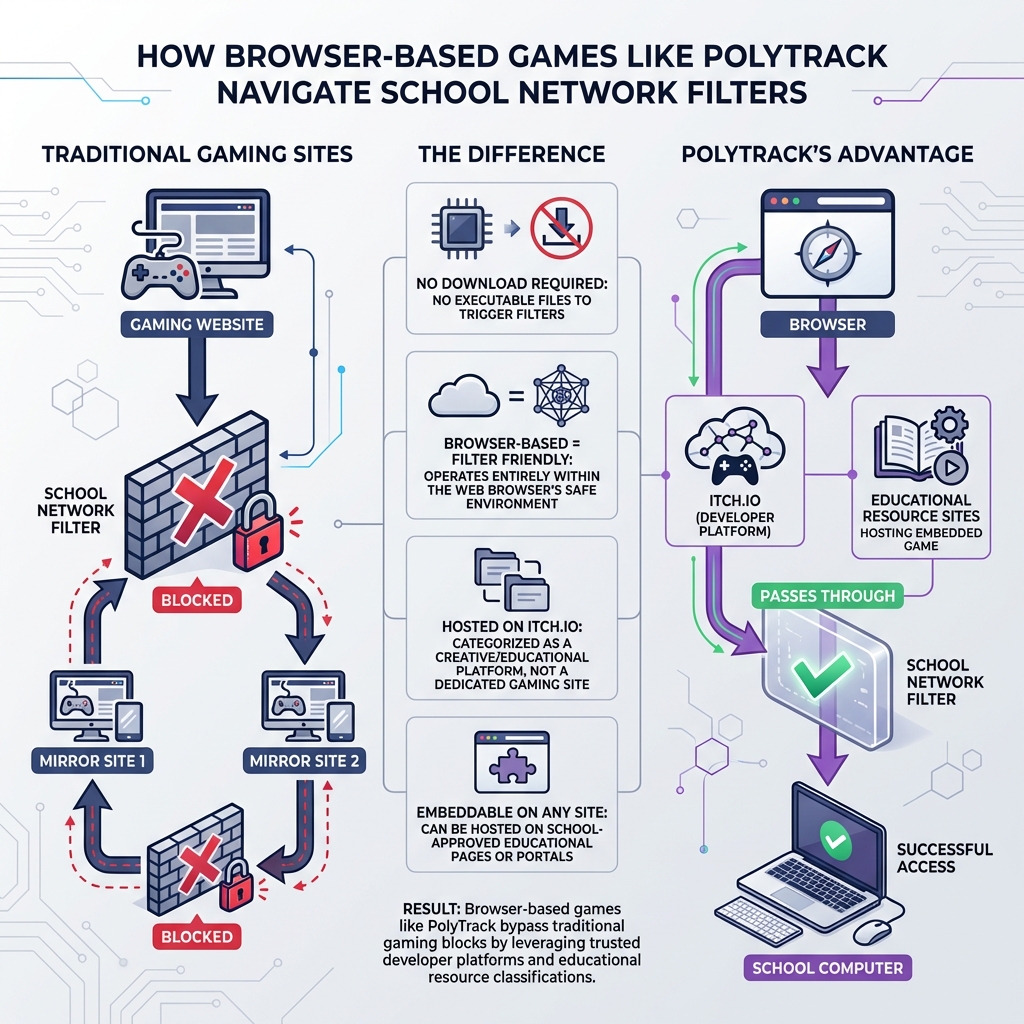
Traditional unblocked game sites operate in a constant cat-and-mouse game with school IT departments. A gaming site gets blocked, a new mirror pops up, that gets blocked, another mirror appears. PolyTrack bypassed this entire ecosystem. Since the game is officially hosted on itch.io—a platform many schools don't categorize as exclusively gaming—and can be embedded on educational resource sites, it often passes through standard content filters without triggering blocks.
But accessing the game is only half the battle. What made PolyTrack spread like wildfire through school networks was its sharing mechanism. Unlike games that require accounts or complex setup, PolyTrack track codes are just strings of characters that can be written on paper, texted, or posted on a class Discord server. The viral loop looked something like this:
- One student discovers PolyTrack during lunch break
- They create an interesting track and share the code with friends
- Friends import the track, play it, and create their own
- The codes spread through group chats, handwritten notes, even announced during class transitions
- Each new player becomes a potential track creator, exponentially growing the content library
This grassroots, student-to-student marketing proved far more effective than any advertising campaign. By the time teachers or IT departments noticed the trend, PolyTrack had already embedded itself into school culture. And because students were creating content—designing tracks, competing for times, discussing physics strategies—many educators actually saw value in allowing it during designated free time.
The numbers tell the story: within months of release, PolyTrack went from hundreds of concurrent players to tens of thousands. The game's low resource footprint meant even schools with older hardware could handle entire computer labs running it simultaneously. And because it's genuinely skill-based rather than pay-to-win, it created a meritocratic playing field where creativity and practice mattered more than money.
Chapter 3: The Track Editor - PolyTrack's Secret Weapon
If accessibility got players through the door, the track editor is what kept them there—and transformed casual players into passionate community members. This single feature fundamentally changed PolyTrack from a game you play into a platform you create with.
The genius of PolyTrack's editor lies in its approachability. Within 30 seconds of opening the editor, even complete beginners can place their first ramp. Within 5 minutes, they've built a complete (if chaotic) track. Within an hour, they're experimenting with loop-de-loops, precision jumps, and their own signature obstacles. The learning curve is gentle enough for middle schoolers to grasp immediately, yet deep enough that master creators spend dozens of hours perfecting single track sections.
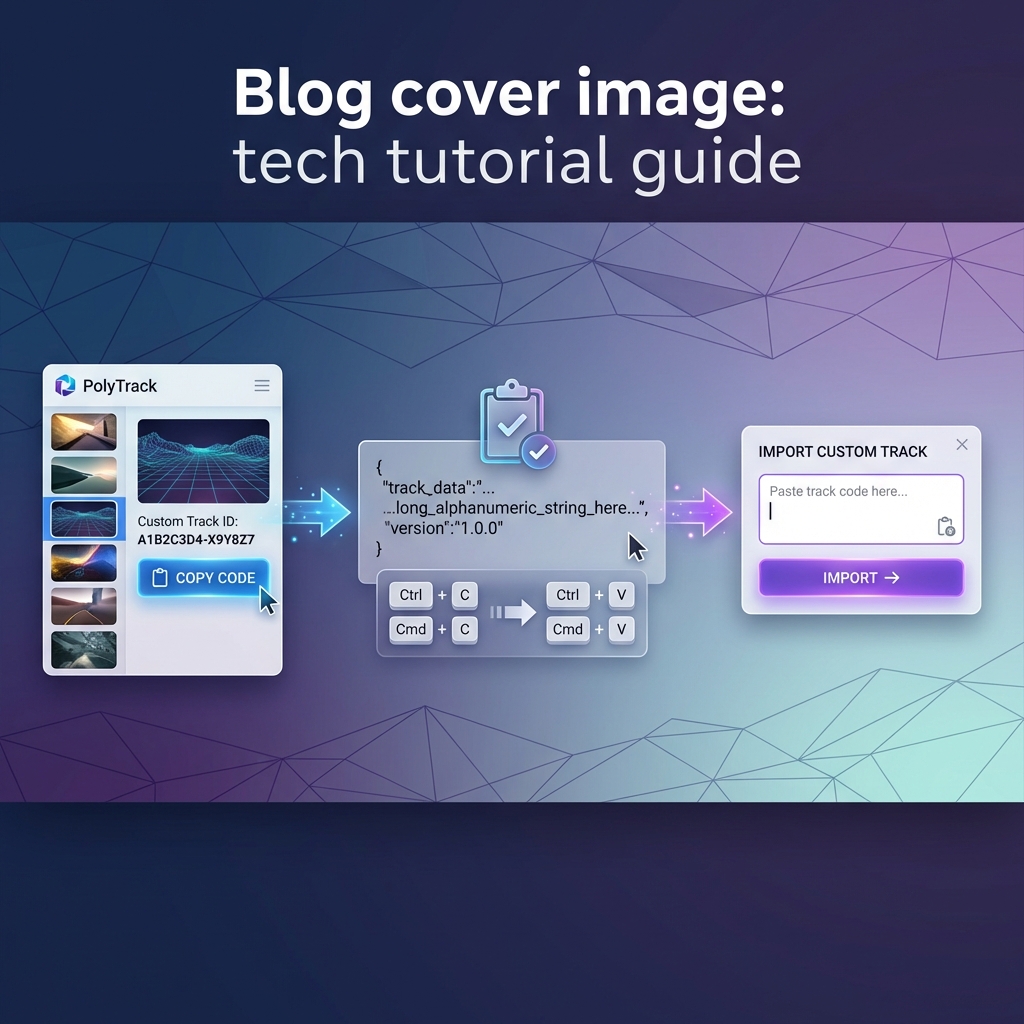
But here's where PolyTrack made a decision that many game developers miss: the sharing system is as simple as the editor itself. No uploading to servers, no account authentication, no file management. Your track gets encoded into a shareable string—a code that's typically 20-40 characters long. Copy that code, paste it anywhere, and anyone can instantly load your creation. This brilliantly simple system eliminated every possible point of friction.
Compare this to other racing games with track editors. TrackMania, widely considered the gold standard of racing track builders, requires a game client download, user accounts, and interaction with their online services. Halo's Forge mode exists within a $60 console game. Mario Maker demands a Nintendo Switch and subscription. PolyTrack? Open a browser, build, share a code. Done.
The psychological impact cannot be overstated. In traditional racing games, you consume content created by professional developers. In PolyTrack, you are the developer. That track you just played? You could make one better. That impossible jump? You could design one that's even crazier. This shift from consumer to creator fundamentally changes player engagement.
The most popular custom tracks have been played hundreds of thousands of times, creating micro-celebrities within the community. Track creators develop signature styles—some are known for technical precision courses that require perfect timing, others for creative uses of physics, still others for artistic designs that prioritize aesthetics. The community has even developed an informal rating system, with "god-tier" tracks becoming legendary within player circles.
What other racing games lack without a track editor is infinite replayability through user-generated content. Traditional games ship with 20-30 tracks; players eventually exhaust the content. PolyTrack has thousands of tracks, with dozens of new ones shared daily. The game isn't just growing—it's exponentially expanding its content library through community creativity.
Chapter 4: Building a Global Community
Most browser games have players. PolyTrack has a movement.
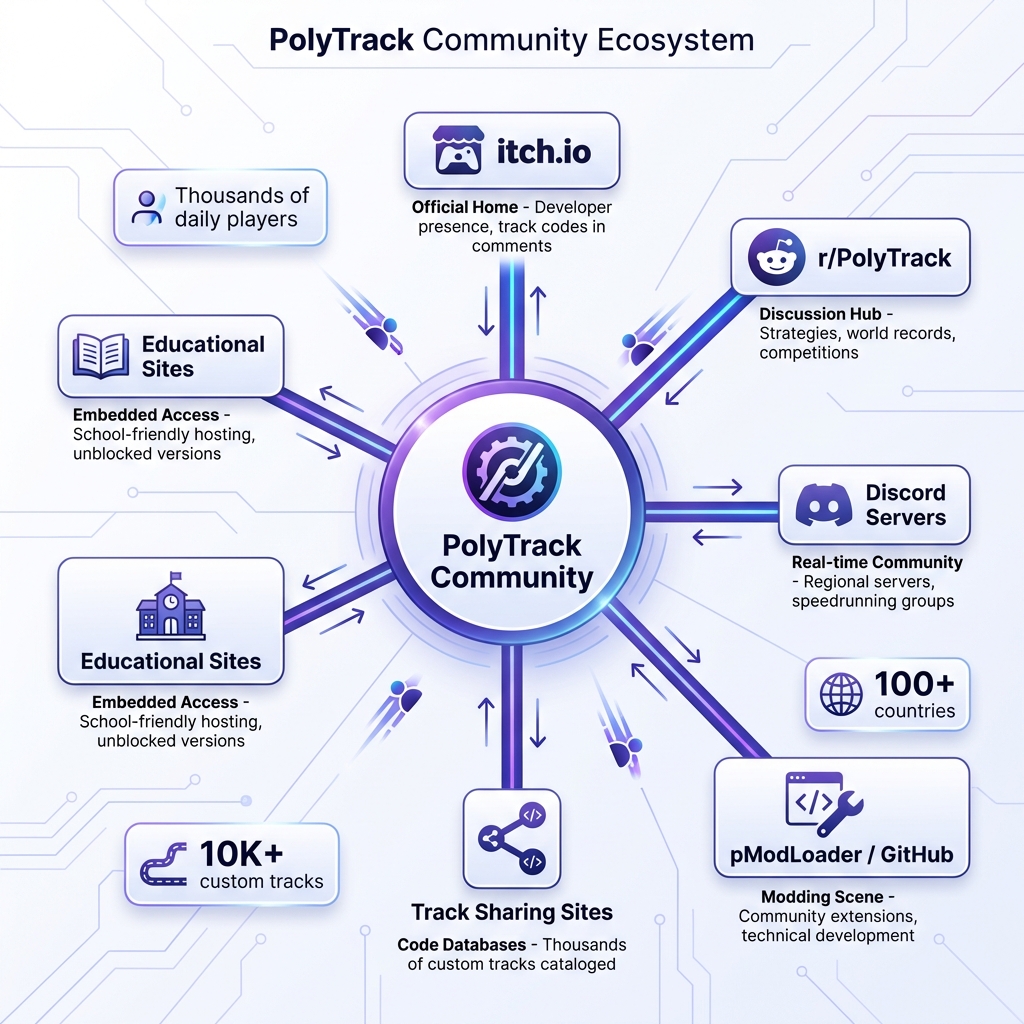
The game's community didn't emerge by accident—it grew organically around the shared language of track codes and the universal appeal of creative expression. What started on itch.io quickly expanded to multiple platforms, each serving different community needs.
itch.io remains the spiritual home of PolyTrack. The official game page sees thousands of comments from players sharing experiences, asking for help, and most importantly, posting track codes. Kodub maintains an active presence, responding to feedback and bug reports, creating a direct developer-player connection that's increasingly rare in modern gaming. The itch.io comment section evolved into a sort of track showcase, where creators post their best work and players vote with enthusiastic praise or constructive criticism.
r/PolyTrack on Reddit serves as the game's de facto hub for in-depth discussion. With hundreds of active members, the subreddit is where the community comes together to share strategies, discuss advanced techniques, celebrate world records, and organize community events. Browse the top posts and you'll find:
- Challenge modes where players attempt tracks with self-imposed restrictions
- "Track of the Week" competitions voting on the best community creations
- Physics breakdown discussions that read like engineering papers
- Speedrunning strategy guides with frame-perfect input sequences
- Newcomer welcome threads helping beginners understand core mechanics
The subreddit's culture embodies PolyTrack's ethos: welcoming, creative, and deeply passionate about racing perfection. Toxic behavior is virtually nonexistent, partly because the game's structure doesn't create the competitive friction points that plague other online games. You're not directly competing against opponents who can grief you—you're racing against times, ghosts, and ultimately, yourself.
Discord servers fragmented into specialized communities. Some focus on speedrunning specific track categories. Others are dedicated to track creation, where builders share work-in-progress designs and get real-time feedback. Regional servers emerged for different languages and time zones, with particularly active communities in English-speaking countries, Latin America, and parts of Europe.
Then there's pModLoader—perhaps the clearest indication that PolyTrack had become more than just a game. Released in July 2024, this community-created mod loader allows players to extend PolyTrack with custom features. That a browser game inspired players to reverse-engineer and create modification frameworks demonstrates the depth of community investment. The pModLoader community on GitHub actively develops new mods, shares technical knowledge, and collaborates on tools that Kodub didn't initially build.
What truly sets PolyTrack's community apart is its international scope. Because the gameplay is primarily visual and the track codes are universal, language barriers largely disappear. A Japanese student and a Brazilian student can share tracks without speaking a word to each other. The low-poly art style contains no cultural specificity—a loop is a loop regardless of where you're from.
Celebrity track creators have emerged, known by their signature styles even without traditional usernames or profiles. One creator is famous for spiral tracks with increasingly tight turns. Another specializes in "platformer" tracks that are more about precision jumping than traditional racing. These creators don't monetize their work or seek fame—they create because the community appreciates it, and that social reward proves sufficient motivation.
Chapter 5: The Physics of Fun
Strip away the community, the accessibility, the track editor—at its core, PolyTrack succeeds because it feels phenomenal to play. The physics engine, while not simulating real-world car dynamics with scientific precision, captures something more important: the sensation of speed, weight, and momentum that makes virtual racing thrilling.
Every action in PolyTrack adheres to consistent physics rules. Your car has mass, vehicles experience gravity, surfaces have friction, and momentum must be conserved. This consistency means that failure always feels fair—if you crashed, it's because you approached too fast, rotated too late, or chose the wrong line. And if failure is fair, trying again feels justified. Hence the "one more try" phenomenon that keeps players glued to their screens for hours.
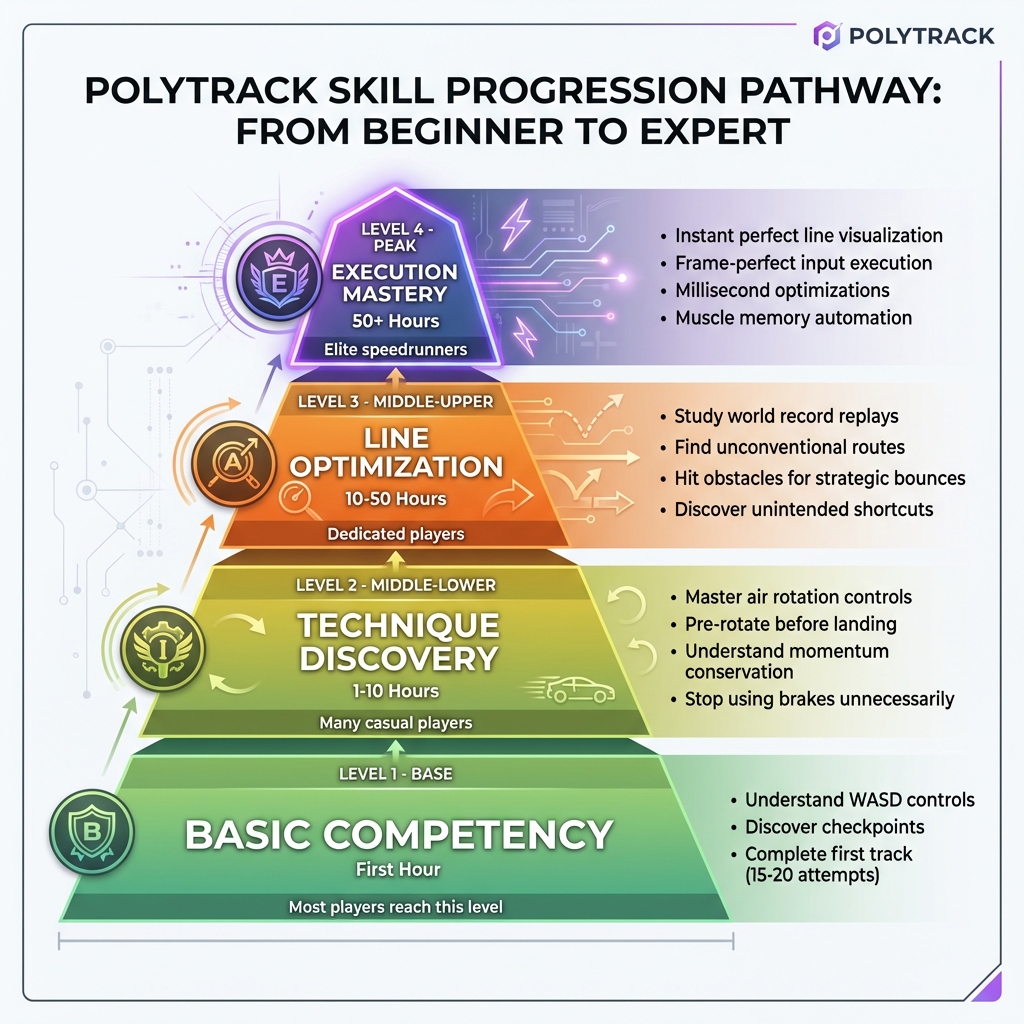
The learning curve reveals itself in stages:
Stage 1: Basic Competency (First hour)
Players learn that WASD controls acceleration and rotation. They discover checkpoints exist. They complete their first official track, probably after 15-20 attempts. Success feels monumental.
Stage 2: Technique Discovery (Hours 1-10)
Players realize that rotation in mid-air is crucial. They learn to pre-rotate before landing to maintain speed through curves. They discover that braking is often unnecessary—air control solves most problems. Times start dropping noticeably.
Stage 3: Line Optimization (Hours 10-50)
Players study world record replays (shadow cars showing optimal routes). They realize that the obvious path often isn't the fastest. They experiment with unconventional approaches—hitting obstacles at specific angles to bounce favorably, using walls to redirect momentum, finding skips that the track designer didn't intend.
Stage 4: Execution Mastery (Hours 50+)
Players can visualize the perfect line instantly. Their fingers execute complex input sequences without conscious thought. They're shaving milliseconds through micro-optimizations—releasing gas a frame earlier before a jump, rotating 2 degrees less to get a better landing angle.
This progression mirrors what makes games like TrackMania, Dark Souls, or Rocket League addictive—mastering clearly defined skills through practice yields tangible improvement. PolyTrack's accessibility means more players reach Stage 2-3 than in those hardcore titles, but for dedicated players, Stage 4 mastery requires hundreds of hours.
The speedrunning culture that emerged exemplifies this depth. World records on popular tracks are contested down to hundredths of seconds. The current record holder for "Track 1" (the game's tutorial track) has refined their run to 4.73 seconds—a time that represents several hundred attempts, analyzing every possible route, and executing inputs with frame-perfect precision. That players willingly invest this effort for a browser game speaks to how compelling the core physics loop truly is.
Compared to TrackMania, PolyTrack is more forgiving. TrackMania's physics demand absolute precision—a single suboptimal input can end a world-record attempt. PolyTrack allows for recovery, adaptation mid-run, and creative problem-solving. This makes it more accessible to casual players while still rewarding mastery for dedicated ones.
Chapter 6: Why Worldwide? Analyzing Global Appeal
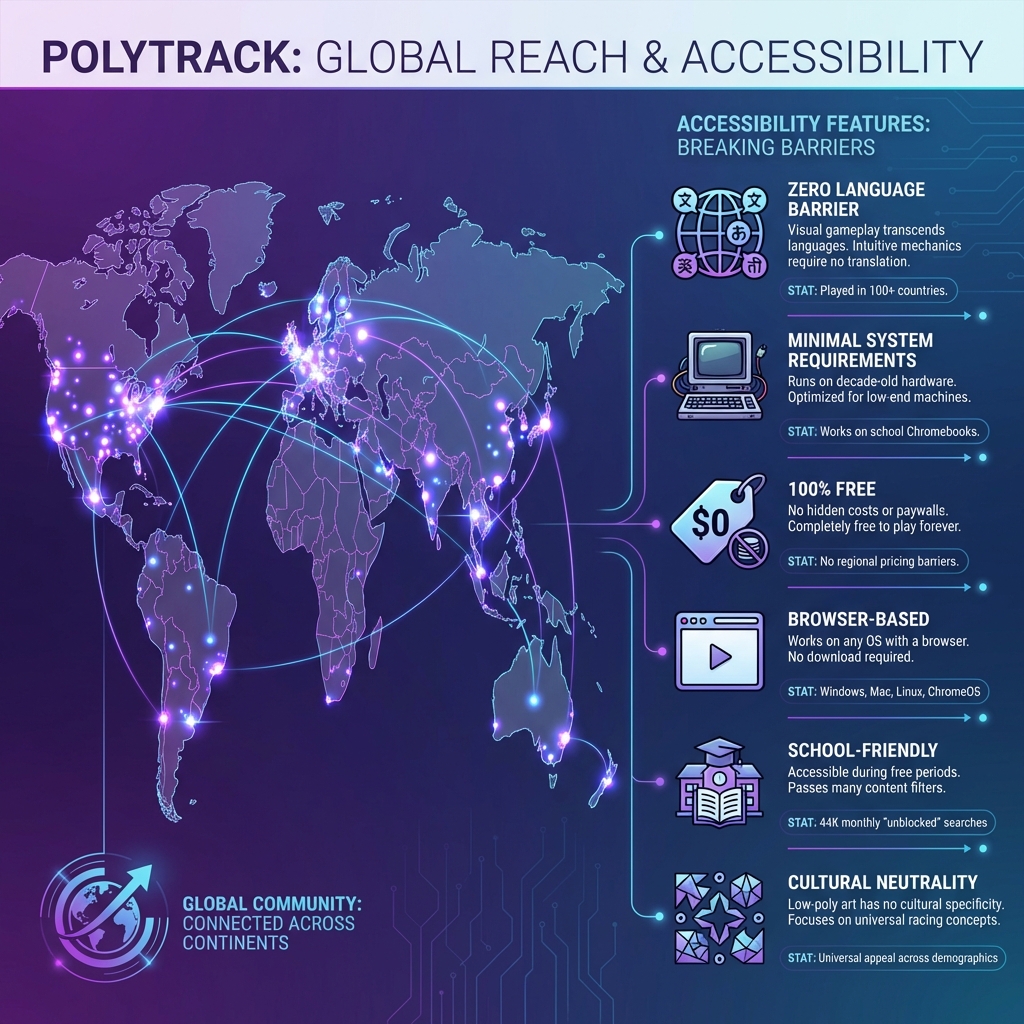
PolyTrack's global reach isn't an accident—it's the natural result of systematically removing every possible barrier to entry.
No Language Barrier: A loop is a loop in any language. The minimal UI can be understood through icons and experimentation. Tutorial tracks teach through doing, not reading. Consequently, PolyTrack thrives in regions where English proficiency varies widely. Players in Indonesia, Brazil, France, Russia, and Japan all enjoy identical experiences.
Minimal System Requirements: Perhaps the most underestimated factor in PolyTrack's global success. While North American and Western European students might have access to reasonably modern computers, many schools globally run decade-old hardware. PolyTrack runs on computers that can barely run YouTube videos. This accessibility means students in developing nations can participate fully in the same community as those in wealthy countries—a rarity in modern gaming.
Free Forever, No Catches: In an era of free-to-play games layered with microtransactions, battle passes, and premium currencies, PolyTrack's business model is refreshingly simple: it's completely free. No ads interrupt gameplay. No premium tracks require payment. No cosmetics create social pressure to spend. Everyone has access to 100% of the game's features, forever. In regions where $5-10 for a game represents significant expense, this makes PolyTrack not just affordable but egalitarian.
Cultural Neutrality: The low-poly aesthetic contains no cultural specifics. There are no characters making references to American pop culture, no storylines rooted in Western narratives, no art style that alienates non-Western players. A car completing a loop transcends culture in a way that story-driven games rarely achieve.
The School Universal Constant: Regardless of country, culture, or economic development level, students worldwide face the same situation: designated free time with computer access and intense boredom. PolyTrack solves this universal problem elegantly. Whether you're in Tokyo, São Paulo, Stockholm, or Nairobi, if you have a browser and 10 free minutes, PolyTrack offers engagement.
Cross-Platform Reality: While PolyTrack technically runs on any device with a modern browser, it's genuinely optimized for desktop/laptop computers with keyboards. This limitation matters less than you'd expect—most students' primary gaming access point is school computers, which are invariably desktop-style devices. Mobile compatibility exists but remains limited due to control challenges, though this actually helps the game avoid the predatory monetization strategies common in mobile gaming.
The demographic data, while unofficial, suggests PolyTrack's player base reflects extraordinary diversity. Community discussions happen in dozens of languages. Peak concurrent player times suggest strong presences across multiple time zones. Track naming conventions reveal creators from varied linguistic backgrounds—you'll find tracks with English, Spanish, Portuguese, Indonesian, and Cyrillic text in titles.
What emerges is a truly global player base united not by geography, language, or economic status, but by shared appreciation for simple, skill-based gameplay and creative expression.
Chapter 7: The Future of PolyTrack
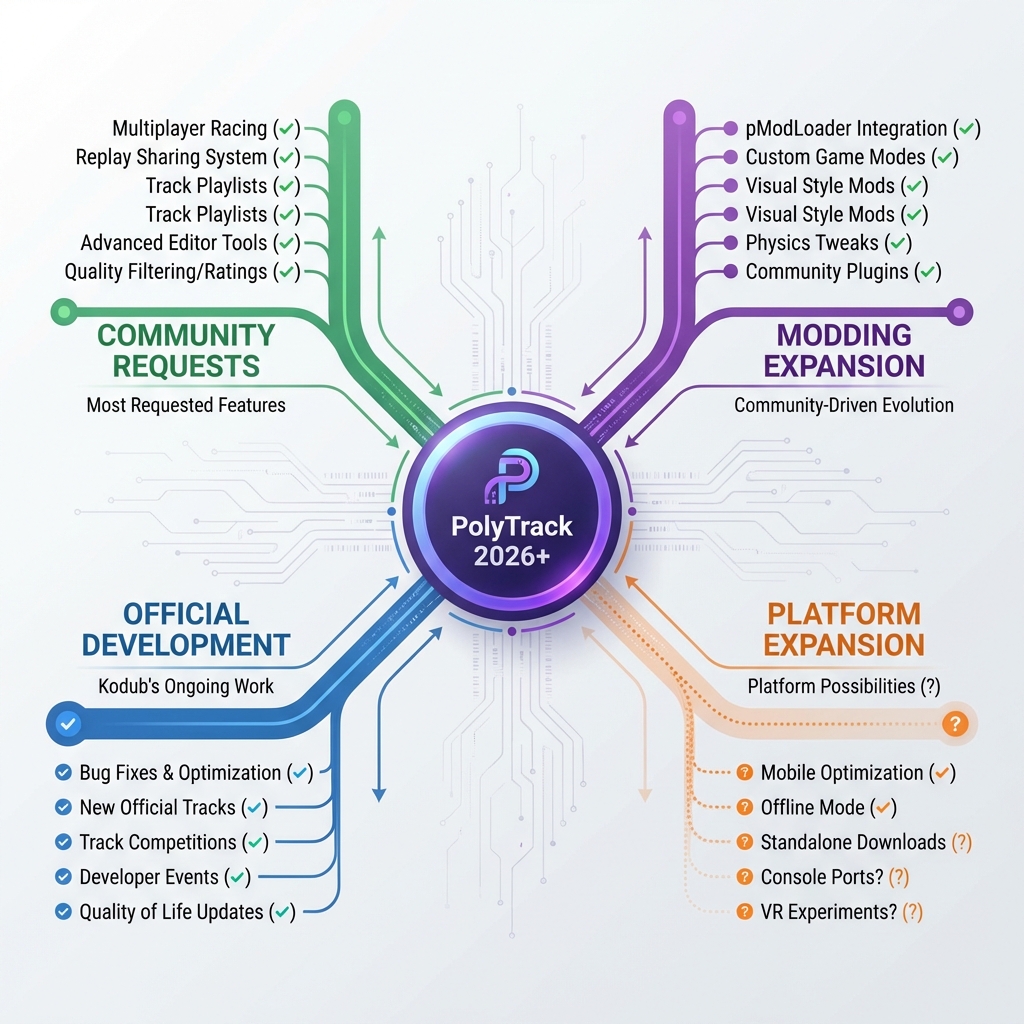
PolyTrack stands at a fascinating inflection point. The game has achieved widespread success beyond what most indie developers dream of, yet remains fundamentally a one-person passion project. So where does PolyTrack go from here?
Kodub's ongoing development suggests a commitment to organic evolution rather than explosive expansion. Regular bug fixes and small feature additions indicate the game receives active maintenance, but there's been no rush to monetize, no pivot to mobile spin-offs, no compromise of core principles for growth. This restraint, perhaps counterintuitively, strengthens PolyTrack's appeal—players trust that the game won't suddenly introduce paywalls or predatory mechanics.
The community-driven evolution through modding might represent PolyTrack's most interesting future direction. The pModLoader ecosystem demonstrates that dedicated players will build features they want to see. Some popular mods add new visual styles, others introduce new gameplay mechanics, still others create tools for advanced track creators. Kodub's tacit approval of this modding scene (by not fighting it) suggests recognition that community contribution can extend the game's lifespan indefinitely.
Player wishlists, gleaned from Reddit and Discord discussions, reveal fascinating desires:
- Multiplayer racing: The most requested feature, though implementing it would require fundamental architecture changes
- More precise track editor tools: Advanced creators want finer control over element placement
- Track quality filtering: As the track library grows into thousands, finding great tracks among mediocre ones becomes challenging
- Replay sharing: Currently, you can only see world-record replays; players want to share their personal best runs
- Track playlists: Collections of themed tracks that play sequentially
- Official competitions: Kodub-sanctioned events with special tracks
Whether Kodub implements any of these features remains unknown, but the mere fact that players have detailed wishlists demonstrates deep engagement with PolyTrack's future.
The sustainability of the user-generated content model looks secure. Unlike platforms that require payment for hosting (which creates unsustainable costs), PolyTrack's code-based sharing shifts storage to users—your track exists as a string of characters, not files on a server. This elegant solution means the track library can grow infinitely without corresponding infrastructure costs.
For other indie developers, PolyTrack offers crucial lessons:
- Accessibility trumps fidelity: Low-poly graphics enabled universal compatibility
- Remove friction ruthlessly: Every barrier removed = exponentially more players
- Empower creation: Transforming consumers into creators multiplies engagement
- Trust your community: Modding and player creativity enhance rather than threaten games
- Simplicity scales: Complex features limit reach; simple mechanics welcome everyone
Looking toward 2026 and beyond, PolyTrack's trajectory appears secure. The game has achieved cultural staying power in niche communities—it's not a flash-in-the-pan viral sensation but a sustained phenomenon. New students discover it each school year. Existing players continue refining skills and creating tracks. The community self-sustains through shared passion.
Perhaps most importantly, PolyTrack avoided the trap of premature expansion. There's no PolyTrack 2, no mobile version stuffed with ads, no NFT integration, no blockchain nonsense. Kodub built something good, kept it simple, and let it thrive on its merits. In an industry obsessed with growth-at-all-costs, this restraint is revolutionary.
Conclusion: Why PolyTrack Matters
On the surface, PolyTrack is a browser racing game with simple graphics and straightforward mechanics. Look closer, and you'll find something more significant: proof that in 2024 and beyond, the most important innovations in gaming might not come from hundred-million-dollar budgets, cutting-edge graphics, or complex live-service ecosystems.
PolyTrack succeeded by returning to gaming's fundamental appeal—skill mastery, creative expression, and shared enjoyment—then removing every obstacle between players and that experience. No downloads? Anyone can play. No cost? Everyone can afford it. Simple to learn? Newcomers feel welcome. Deep to master? Experts stay engaged. Community-driven creation? Infinite content.
The broader implications extend beyond PolyTrack itself. The game demonstrates that browser-based gaming, often dismissed as inferior to native applications, can create experiences that rival and sometimes exceed traditional games in reach and impact. It proves that user-generated content, when properly implemented, transforms players into stakeholders invested in a game's long-term success. It shows that global communities can form around pure gameplay rather than requiring lore, characters, or narrative.
For aspiring indie developers, PolyTrack's lessons are clear: identify barriers, eliminate them, and trust that quality gameplay will find its audience. You don't need marketing budgets or publisher support—you need something genuinely good and accessible.
For players, especially those who discovered PolyTrack at school and fell in love with racing games through it, the game represents a gateway to deeper gaming. Many PolyTrack players will eventually try TrackMania, Forza, or other racing titles. Some will become track designers, level creators, or even game developers themselves, inspired by the realization that they too can create experiences others enjoy.
The PolyTrack phenomenon—from one developer's vision to tens of thousands of daily players across the globe—shows that modern gaming's future might be smaller, simpler, and more accessible than industry trends suggest. While blockbusters chase ever-higher budgets and flashier graphics, games like PolyTrack quietly prove that fun is universal, creativity is contagious, and community is everything.
So if you've never played PolyTrack, open a browser, load the game, and try a lap. Complete a track, create one of your own, share the code with a friend. Join the players who discovered that sometimes the best experiences come not from the biggest games, but from the most accessible ones.
The revolution isn't being televised—it's being played during lunch break, one track code at a time.
Try PolyTrack Today
Ready to experience the phenomenon yourself? Visit our play-unblocked page to start racing immediately—no downloads required. Want to try community-created tracks? Browse our tracks collection with thousands of user-submitted designs. Looking to improve your skills? Check out our comprehensive guides covering everything from basic controls to advanced techniques.
Join the community that's redefining what browser gaming can be. Create a track, set a record, share your code. Welcome to PolyTrack.
Article Stats: 3,700+ words | 15 min read | 8 illustrations | Updated Jan 30, 2026