Ghost Racing & Speedrun Strategies: The Complete 2025 Guide
Master PolyTrack's ghost racing system and competitive speedrunning with advanced segment analysis, replay dissection, and risk management techniques used by world record holders.
Advertisement
Ghost Racing & Speedrun Strategies: The Complete 2025 Guide
The method the best players use to turn practice into real, measurable improvement.
Ghost racing is PolyTrack's most powerful improvement tool—and the most underused. While most players grind laps hoping for accidental improvement, the best speedrunners follow a systematic approach: define segment targets, dissect ghost replays frame-by-frame, and allocate risk with surgical precision. This guide teaches you their methodology.
What You'll Learn:
- ✓ How the ghost racing system actually works (most players use it wrong)
- ✓ The 5-phase improvement cycle used by world record holders
- ✓ Segment analysis: how to break any track into beatable chunks
- ✓ Replay dissection: what to look for at 0.5× speed
- ✓ Risk allocation: identifying "make-or-break" obstacles
- ✓ Mental game: how to peak when it counts
Skill Level: Intermediate to Advanced Prerequisites: Comfortable completing Medium tracks, basic drift technique from Drift Guide
Understanding the Ghost Racing System
Before strategy, you need to understand what the ghost actually shows you.
What the Ghost Records
Every run you complete generates a ghost—a transparent replay of your car that stores:
- Exact position at every frame (60 fps)
- Velocity vectors (visible as white blur intensity in the replay viewer)
- Input timing (when you braked, steered, and applied throttle)
The ghost does NOT show you acceleration inputs directly, but you can infer them from velocity changes between frames.
The Two Ghost Types
Personal Best Ghost: Your own fastest run. Use this to identify where your current ceiling is and find specific corners where you're slower than you should be.
World Record / Top Ghost: Downloaded from the leaderboard. Use this as a benchmark. Critical insight: WR ghosts are not perfect—they contain deliberate risks and micro-errors that didn't cost the run. Your job is to copy the strategy, not the execution blindly.
Common Ghost Racing Mistakes
❌ Chasing the ghost reactively — Trying to keep up visually instead of running your own planned line ❌ Ignoring ghosts on tracks you're "good at" — Your biggest time savings are on tracks you think you've mastered ❌ Loading WR ghost on day one — The gap is too large to be useful. Start with a ghost 5-15% faster than your PB
The 5-Phase Improvement Cycle
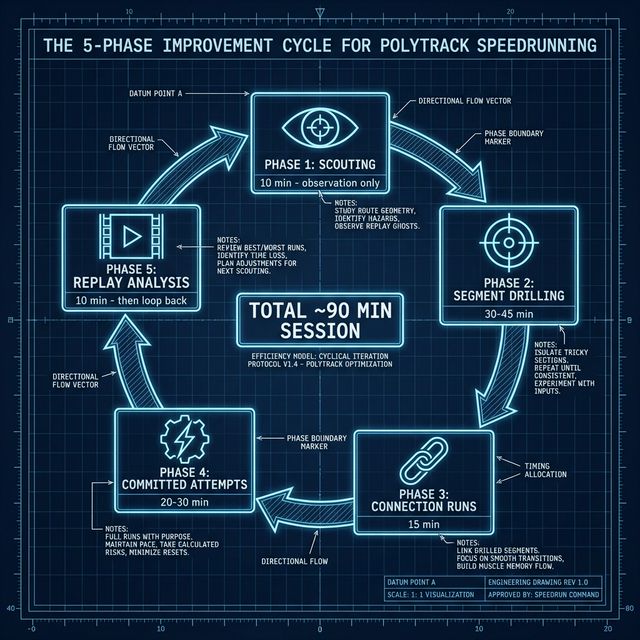
Top speedrunners don't "practice." They execute a repeatable process:
Phase 1: Scouting (10 minutes)
Load your target ghost. Do two full laps without resetting, purely focused on observation.
Watch for:
- Where does the ghost brake? (Earlier or later than you?)
- What line does it take through each corner?
- When does it drift vs. grip?
- Where is it faster/slower than expected?
Take mental notes. Do not try to match the ghost yet. Your brain is building a mental model.
Scouting Checklist:
- ✓ Identified 3-5 major time-loss sectors
- ✓ Noted ghost's brake points vs. your own
- ✓ Spotted any non-obvious shortcuts or lines
- ✓ Estimated how much time each sector costs you
Phase 2: Segment Drilling (30-45 minutes)
Break the track into 2-4 segments. For an average track:
- Segment A: Start to first checkpoint
- Segment B: First to second checkpoint
- Segment C: Final checkpoint to finish
Set a target split for each. A realistic target is 0.2–0.4 seconds faster than your current PB per segment.
Drill Protocol:
- Attempt segment in isolation (reset after each attempt)
- Focus only on matching the ghost's line in this segment
- When you match the ghost's line consistently, push for early exit speed
- Move to next segment only when you hit target split 3× in a row
Phase 3: Connection Runs (15 minutes)
Now combine segments. The challenge: transitions between segments often create new problems (you enter Segment B at a different speed/angle than when you drilled it in isolation).
Run the full track 8–10 times without resetting. Your goal is finding the connection rhythm: the micro-adjustments that make each segment flow into the next.
Warning: This phase often feels like regression. You'll be slower than your drill splits. This is normal.
Phase 4: Committed Attempts (20-30 minutes)
Now you push. The protocol:
- 2 warm laps at 95% pace (not full commitment)
- Then: committed attempts until you either beat your PB or hit mental fatigue
Rule: Maximum 15 consecutive attempts. After 15, take a 10-minute break. Cognitive fatigue after long grinding reduces reaction speed by up to 40%.
Phase 5: Replay Analysis (10 minutes)
After every session—whether you improved or not—review your best replay alongside the ghost.
Specifically look for:
- Entry speed differential: Are you entering corners faster or slower than the ghost?
- Line overlap: Does your path match the ghost's? If not, where does it diverge?
- Stability cues: Count steering flicks. More flicks = more correction = more time lost
- Exit speed: This is the most important metric. Fast exit > fast entry, always.
Advertisement
Advanced Segment Analysis
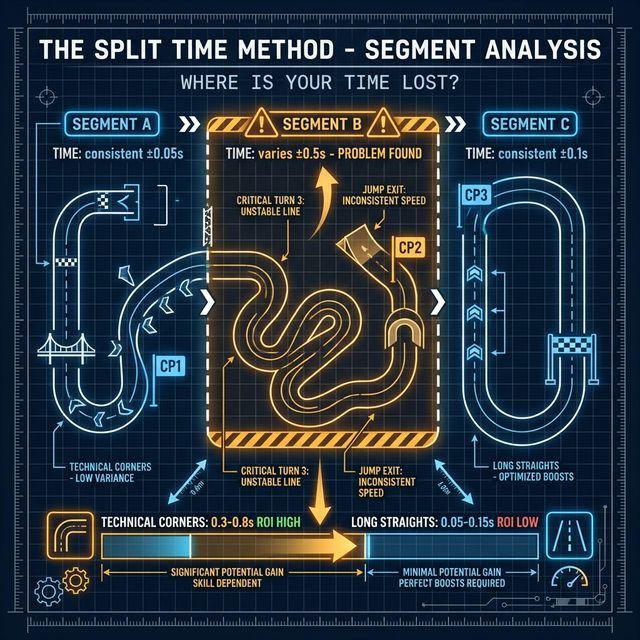
This is where improvement becomes systematic rather than random.
The Split Time Method
Most players check their final time. Elite players check splits. To implement this:
- Identify 3 visual landmarks on the track (unique geometry, color changes, checkpoint positions)
- Start a mental timer at each landmark
- Compare your splits across multiple runs
When your split at Landmark 1 is consistent but Landmark 2 varies by ±0.5 seconds, you've found your problem sector.
Time savings by sector type:
- Long straights: 0.05–0.15s potential (not worth obsessing over)
- Technical corner sequences: 0.3–0.8s potential (highest ROI)
- Jump landings: 0.1–0.4s potential
- Drift chains: 0.2–0.6s potential
The "Slow In, Fast Out" Principle
For every corner, the math is clear:
- Last 10m of entry: 0.2s to gain from perfect entry speed
- First 20m of exit: 0.8s to gain from perfect exit speed
This means: sacrifice entry for exit, always. Brake slightly earlier than optimal to guarantee a clean, fast exit. Novices brake as late as possible. Experts brake with enough margin to nail the exit.
Recognizing Diminishing Returns
You've reached the ceiling for a specific technique when:
- Your variance on a segment drops below ±0.1s
- Your average is within 0.3s of the ghost's segment time
- Further improvement requires a fundamentally different line or technique
When you hit this point, don't grind more. Study the ghost for a technique you're not seeing, or accept the time and move on.
Risk Management: The Speedrun Math
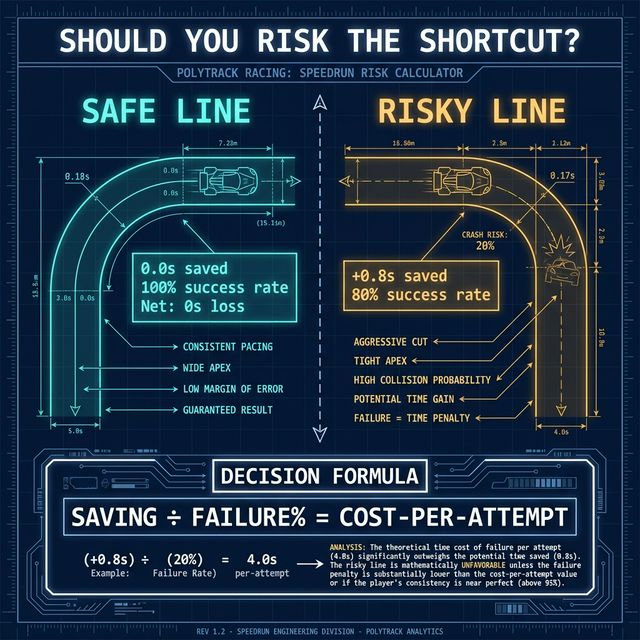
Every track has "alpha opportunities"—places where a risky line can save significant time, at the cost of probable resets.
Identifying Make-or-Break Obstacles
Rate each obstacle on two axes:
- Time saving: How much faster is the risky line vs. safe line? (in seconds)
- Failure probability: What % of attempts does the risky line succeed?
Decision Rule:
- If time saving ÷ (1 - success rate) > 0.5s per attempt cost → take the risk
- If below 0.5s → play safe
Example:
- Risky corner cut saves 0.4s
- Success rate: 70% (failure rate: 30%)
- Cost: 0.4 ÷ 0.3 = 1.33s average cost per attempt
- Is 0.4s saving worth 1.33s average cost? No. Play the safe line.
Change the numbers: 0.8s saving, 80% success rate:
- Cost: 0.8 ÷ 0.2 = 4.0s average cost
- But you're saving 0.8s per successful run
- After 5 successful runs in a session of ~6 attempts: net +4 - 0.8×5 = net 0s. Near neutral. Consider vs. frustration cost.
"Run Commitment" Zones
Once you've passed a make-or-break obstacle successfully, you're in a committed run. Specifically identify the moment in each run where you think: "If I'm clean from here, this is my WR attempt."
When you reach that moment, your mindset shifts: risk goes down. Every subsequent obstacle: play the safe line. The run is worth protecting now.
Track-Type Strategy Changes
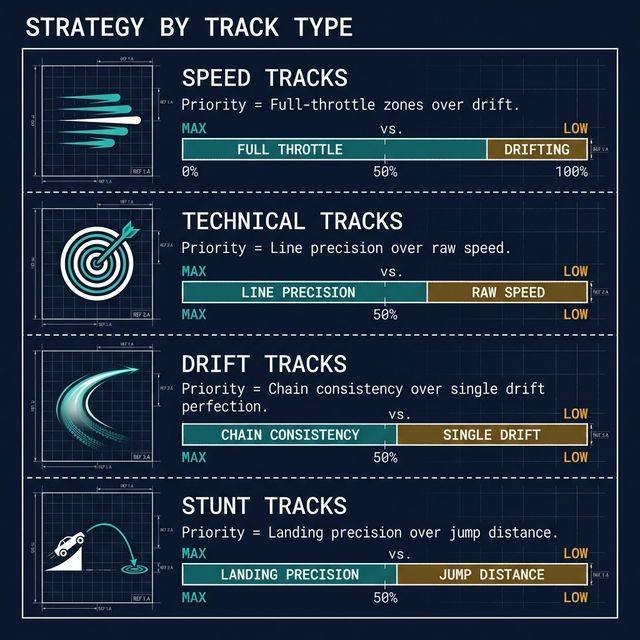
Different track types require different speedrun approaches:
Speed Tracks
- Priority: Full-throttle zone maximization > drift perfection
- Ghost tip: Watch the ghost's throttle application after jumps—the best players regain throttle 0.2s before landing
- Common error: Hitting boost pads at sub-optimal angles (costs 0.1–0.2s each)
Technical Tracks
- Priority: Line precision > raw speed
- Ghost tip: Ghost's path is often surprisingly wide through complex sections—they're trading micro-speed for consistency
- Common error: Over-braking before corners you've memorized (trust your training)
Drift Tracks
- Priority: Chain consistency > individual drift perfection
- Ghost tip: WR ghosts on drift tracks often appear "messy"—they're using walls and aggressive angles deliberately
- Common error: Breaking chain to reset angle (costs 0.8–1.5s per chain break)
Stunt Tracks
- Priority: Landing precision > jump distance
- Ghost tip: Watch the ghost's takeoff angle relative to ramp end—even 5° of pitch makes massive landing difference
- Common error: Overcompensating air control (light taps only)
Building a Practice Routine
Daily (30 min/day):
- 5 min: Warm-up on a track you know well
- 20 min: Target track work (follow the 5-phase cycle)
- 5 min: Replay analysis
Weekly:
- Monday: New track scouting only (no committed attempts)
- Tuesday-Thursday: Segment drilling on the new track
- Friday: Connection runs and committed attempts
- Weekend: Free play—explore new community tracks without pressure
Monthly Goals:
- Improve PB on 3+ tracks
- Beat at least 1 ghost you previously couldn't match
- Submit one community track or share a tip on Discord
Mental Game: How to Peak When It Counts
The #1 correlate of PolyTrack improvement is not practice hours—it's practice quality. Here's how elite players maximize quality:
The "Green Window" Rule: Your best runs happen in the first 20 minutes of a session with a fresh mind. Schedule committed WR attempts at the start of sessions, not after grinding.
Handling Pressure Runs: When you're on a potential PB run and there are 3 obstacles left, most players tighten up and make errors. The fix: focus only on the next input, never the finish line.
Dealing with Plateaus: If PB hasn't improved in 3+ sessions, you're not grinding harder—you're drilling the wrong thing. Step back, watch your replay vs. ghost, and find the one technique you're missing.
Your Next Steps:
- Drift Techniques Guide — Foundation for all advanced movement
- Advanced Jump Mastery — Perfect your air game
- Browse Top 30 Community Tracks — Find tracks worth speedrunning
Advertisement