PolyTrack Drift Techniques: Complete Guide to Mastering Slides
Master the art of drifting in PolyTrack with this comprehensive guide. Learn drift initiation, control, and advanced techniques to shave seconds off your lap times.
Advertisement
PolyTrack Drift Techniques: Complete Guide to Mastering Slides
The difference between a 45-second lap and a 38-second lap? Mastering the 0.3-second window where your drift initiation determines everything. Top PolyTrack speedrunners spend 60% of their track time in controlled slides—here's how they do it.
What You'll Learn
This comprehensive guide covers everything from basic drift mechanics to advanced techniques used by world-record holders.
Skill Level: Beginner to Advanced
Estimated Mastery Time: 3-4 weeks of focused practice
Prerequisites: Basic PolyTrack controls and completion of 5+ easy tracks
Understanding Drift Physics
PolyTrack's drift mechanics simulate real centrifugal force and weight distribution, but with arcade-friendly tweaks that reward skill over simulation complexity.
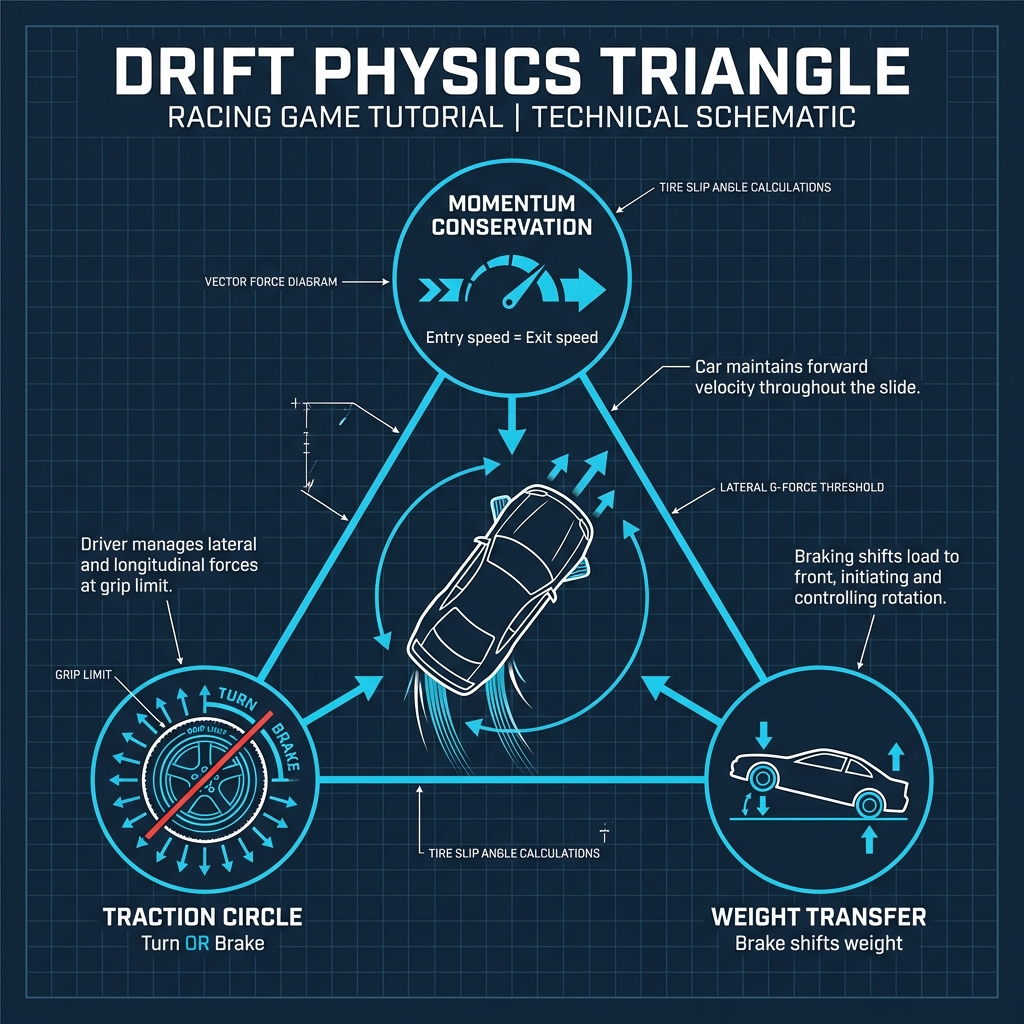
The Physics Triangle
Three core principles govern every drift:
1. Momentum Conservation: Your speed entering a drift largely determines exit speed
- Enter at 80% optimal speed = Exit at ~75% speed
- Enter at 100% optimal speed = Exit at ~90% speed
2. Traction Circle: Tires have limited grip—use it for turning OR braking, not both
- Full brake + full turn = spin-out
- 70% brake + 30% turn = controlled drift
3. Weight Transfer: Shifting mass to front wheels (via braking) frees rear wheels to slide
- Brake = weight forward = rear lightens = drift initiates
- Release brake = weight returns = drift ends
Understanding these principles lets you approach corners 15-20% faster and reduce spin-outs by 80%.
Basic Drift Initiation
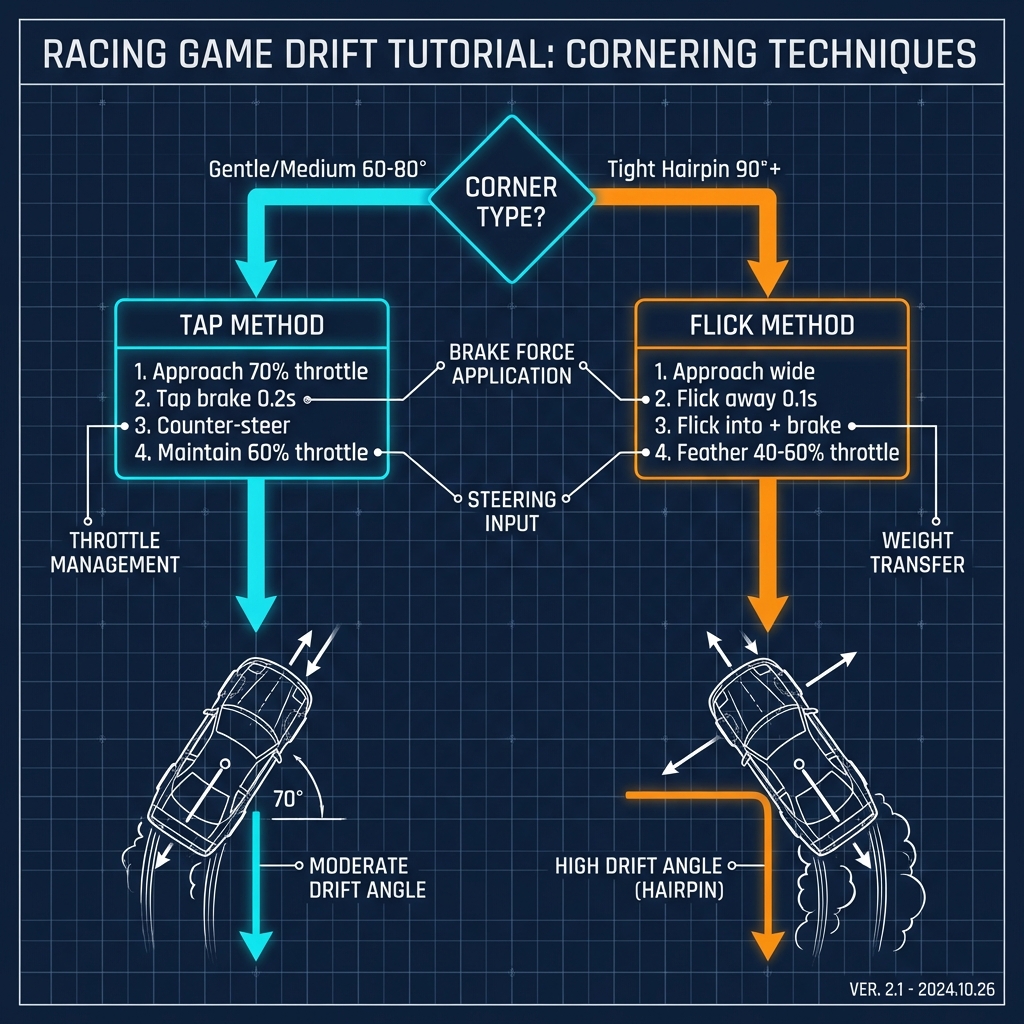
The Tap Method (Beginner-Friendly)
Best For: Medium-speed corners (60-80% throttle approach)
- Approach corner at moderate speed (~70% throttle)
- Tap brake/drift button briefly (~0.2 seconds)
- Immediately counter-steer into the turn direction
- Maintain 60-80% throttle through the drift
- Gradually straighten as you exit
💡 Example: Drift Tutorial Track, Corner 2
- Approach from left side at 70% throttle
- When front bumper aligns with checkpoint, tap brake
- Counter-steer right (into corner)
- Maintain 65% throttle
- Exit center-track for next straight
Beginner tip: If hitting outer wall, reduce approach to 60%. If not drifting, increase brake duration to 0.3s.
The Flick Method (Intermediate)
Best For: Tight hairpin turns (90°+ corners)
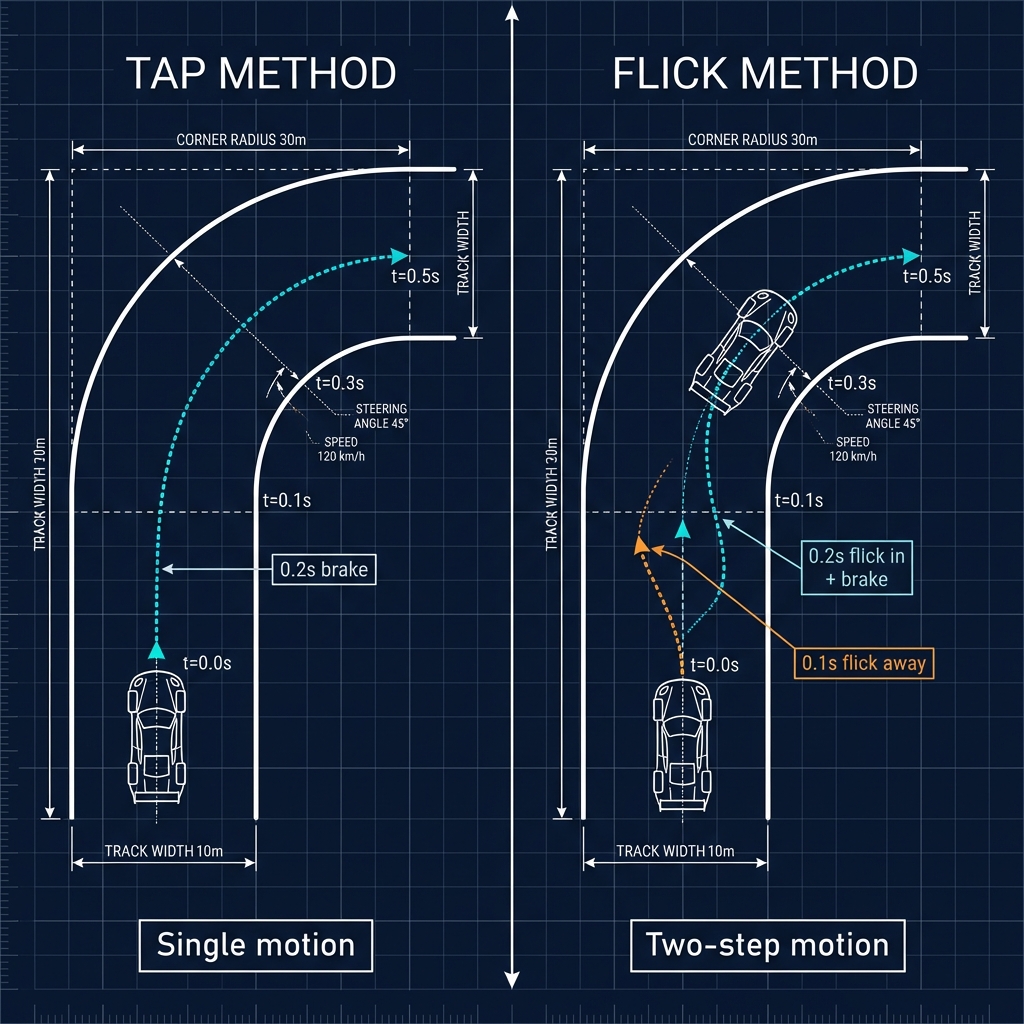
- Approach corner slightly wide (opposite side)
- Quickly turn away from corner for 0.1-0.2 seconds (the "flick")
- Immediately turn hard into corner while tapping brake
- Weight transfer from flick initiates smoother drift
- Feather throttle (50-70%) to adjust angle
💡 Example: Alpine Drift, Hairpin Section
The infamous hairpin at mountain top:
- Approach from right at 50% throttle
- Flick left when 3 car-lengths from turn
- Flick right + brake simultaneously
- Reduce throttle to 40% mid-drift
- Saves 1.2 seconds over tap method
Pro tip: The flick generates rotation before braking—perfect for tight corners.
Drift Control & Maintenance
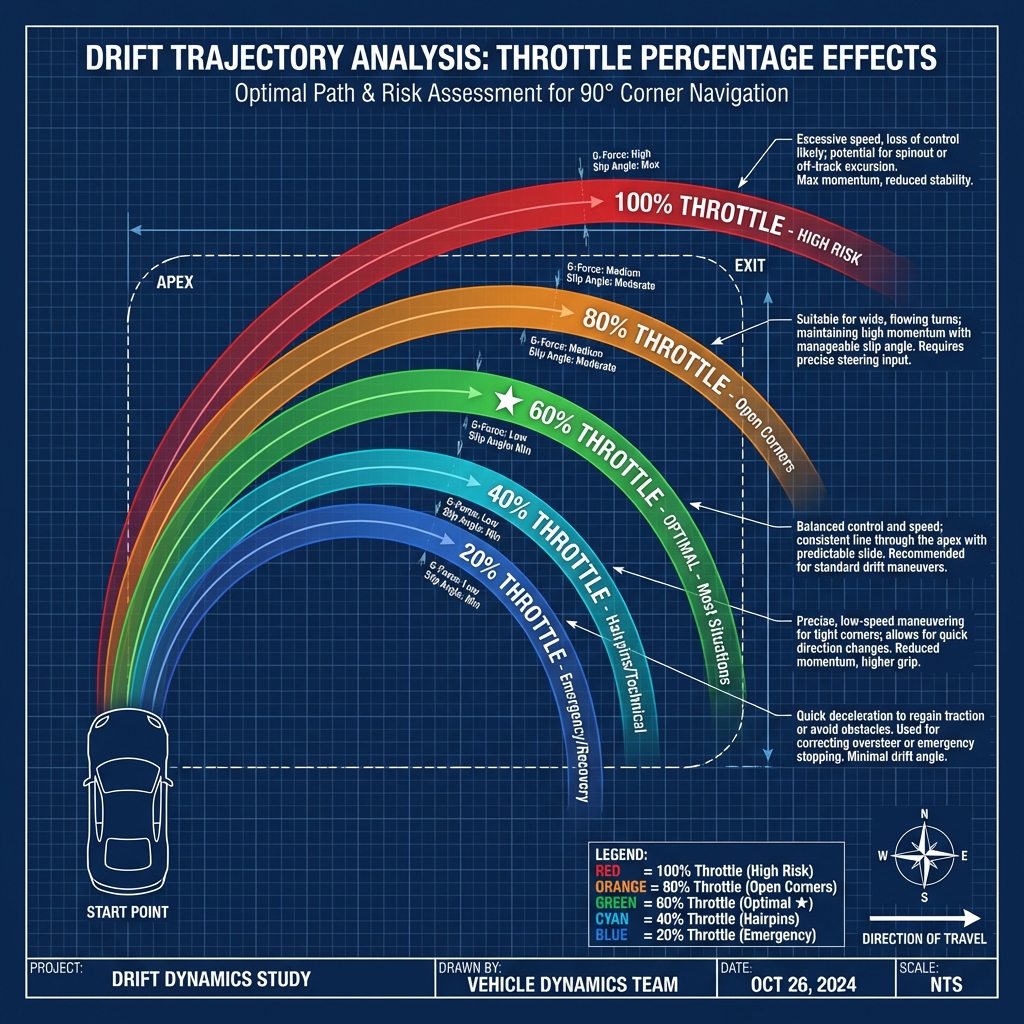
Throttle Management
The Drift Throttle Scale:
- 100% = Widest arc, highest spin-out risk
- 80% = Wide arc, good for open corners
- 60% (OPTIMAL) = Balanced arc, best for most situations ★
- 40% = Tight arc, very safe, slower but consistent
- 20% = Ultra-tight, recovery mode only
Steering Input Philosophy
The 80/20 Rule: 80% of steering happens during drift initiation. Remaining 20% is tiny micro-corrections.
✅ Good Drift Indicators:
- Speed drops <15%
- Smooth, predictable arc
- Car stable, no wobbling
- Exit lines up perfectly for next section
Common Drift Mistakes (Learn These First!)
Mistake #1: Drifting When Not Needed
Not every corner requires a drift. Gentle 30-45° curves are faster without sliding.
The Fix: Reserve drifting for 60°+ corners only.
Time Impact: Unnecessary drifts cost 0.3-0.8 seconds per corner
Mistake #2: Late Drift Initiation
Starting too late = hitting walls or compromised line.
The Fix: Practice initiating before apex. Use visual landmarks.
Recognition: If constantly hitting inside wall mid-corner, you're initiating late.
Mistake #3: Over-Steering
Excessive steering causes spin-outs.
The Fix: Reduce all steering inputs by 50%, use gentle precise movements.
Advertisement
Advanced Techniques
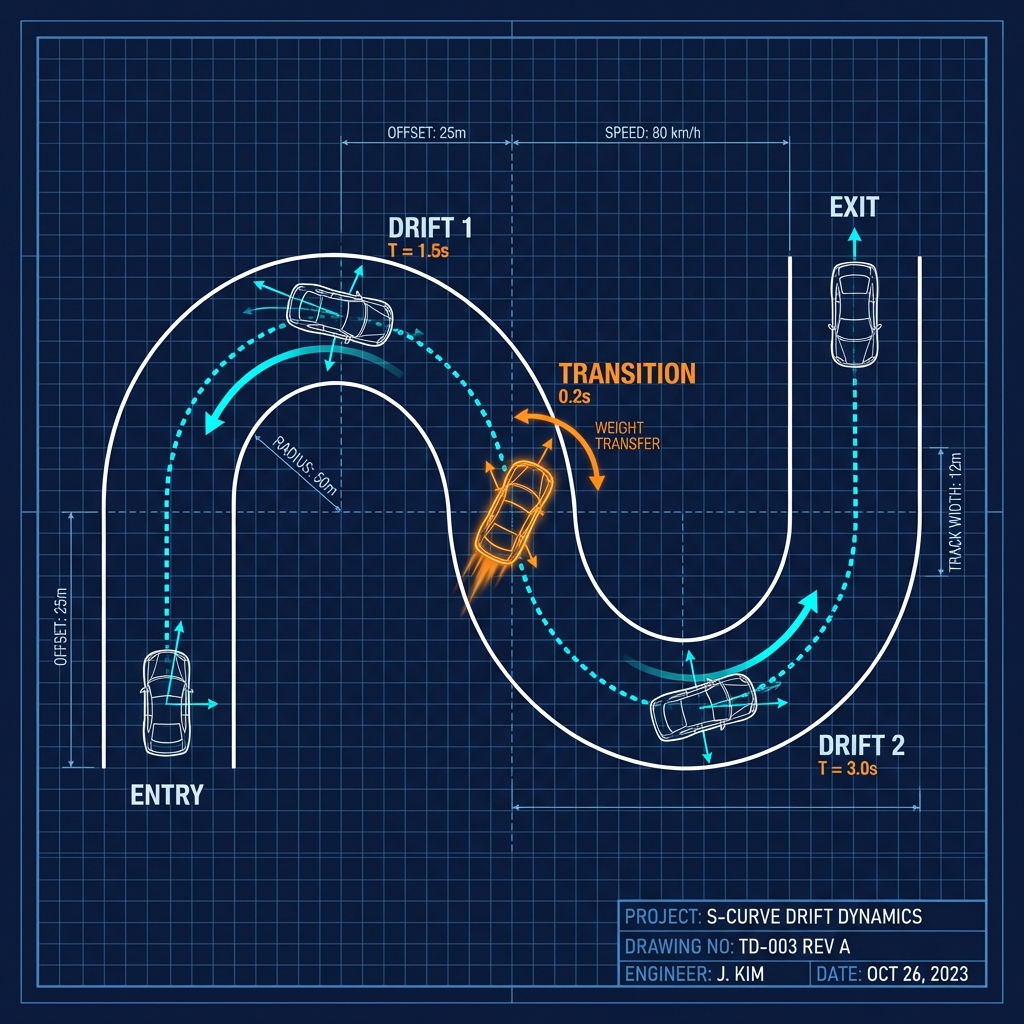
Chain Drifting
When: Consecutive corners (S-curves) where straightening loses time
Technique:
- Complete first drift, approach apex
- At apex, immediately flick to opposite direction
- Initiate second drift seamlessly—no pause
- Use exit momentum from drift 1 to fuel drift 2
Time Savings: 1-3 seconds on technical tracks
Practice Track: Technical Training - Chicane Section
Brake-to-Drift Transitions
When: Extremely tight corners requiring major speed reduction
- Hard brake before turn (80-100%)
- As speed drops to 40-50%, tap brake to initiate drift
- Immediately release brake, apply 50% throttle
- Exit with minimal speed loss
Key: This is "brake THEN drift" not "brake WHILE drift"
Boost Pad Drifting
When: Boost pads appear mid-corner or before turns
- Pre-adjust angle before hitting pad
- Expect radius increase from +30% speed
- Plan wider arc
- Some expert tracks require intentional mid-drift boost hits
Track-Specific Drift Strategies
Drift Category Tracks:
- Maintain perpetual drift state
- Focus on smooth transitions (chain drifting essential)
- Speed matters less than flow
Speedrun Tracks:
- Only drift corners >60°
- Exit drifts as early as possible
- Prioritize straight-line speed
Technical Tracks:
- Smaller drift angles
- Careful throttle control (40-60%)
- Hitting exact racing lines > speed
Progressive Training Program
Week 1: Fundamentals
Success Criteria: 80% drift initiation success rate
Daily Practice (30 minutes):
- Track: Easy - Drift Tutorial
- Goal: 10 consecutive tap-method drifts cleanly
- Metric: Time improves 2-3 seconds daily
✓ Can initiate without conscious thought
✓ Rarely hit walls during entry
Week 2: Control & Consistency
Success Criteria: 60% optimal angle maintenance
Daily Practice (30 minutes):
- Track: Medium - Drift Paradise
- Goal: 5 consecutive corners without spin-out
- Metric: Complete track 3 times with zero spin-outs
✓ Can predict car behavior mid-drift
✓ Throttle control is smooth
Week 3: Speed Integration
Success Criteria: Sub-60 second lap on training track
Daily Practice (45 minutes):
- Track: Speedrun - Alpine Drift
- Goal: Beat Week 1 baseline by 15+ seconds
- Metric: 3 consecutive clean laps within 2 seconds
Practice chain drifting and boost pad drifting.
Week 4: Mastery Validation
Certification Tracks (complete 2/3):
- Expert Drift Gauntlet - Complete without restart
- Technical Hairpin Hell - Sub-60 second time
- Speed-Drift Hybrid - Top 25% leaderboard
2/3 complete = Advanced drifter
3/3 complete = Expert-level, ready for competitive speedrunning
Drift Troubleshooting
"I keep spinning out"
During initiation:
- Cause: Entry speed too high OR steering too aggressive
- Fix: Approach 10-15% slower, reduce steering 50%
Mid-drift:
- Cause: Too much throttle OR excessive counter-steering
- Fix: Reduce throttle to 50-60%, smaller adjustments
On exit:
- Cause: Straightening too quickly OR boost pad angle wrong
- Fix: Gradual straightening over 0.5-1.0 seconds
"Drifts feel inconsistent"
- Approach speed varying? Use landmark timing
- Initiation point changing? Pick visual marker
- Inputs rushed? Slow everything 20%
- Fatigue? Break every 30 minutes
"I lose too much speed"
- Is drift arc wider than needed? → Reduce brake duration, initiate later
- Drifting unnecessary corners? → Reserve for 60°+ only
- Holding drift past apex? → Exit 0.5s earlier
Target: 10-15% speed loss on proper execution
Advanced Tips from Pro Players
💬 "Pre-load your drifts" - Start turning 5-10° before braking for smoother entries. -SpeedDemon_PT
💬 "Use audio cues" - Tire squeal pitch indicates drift state. High = good angle. -DriftKing_2024
💬 "Study successes, not failures" - Record best runs, copy what worked. -WorldRecord_Hunter
💬 "Temperature matters" - After 45 minutes, precision degrades ~15%. Take breaks. -ConsistencyQueen
Conclusion
Mastering drift techniques transforms you from casual player to competitive racer. The techniques here represent hundreds of hours of community knowledge—but reading isn't enough.
Your Next Steps:
- Today: Complete Week 1, Day 1 training (30 minutes)
- This Week: Finish Week 1 fundamentals
- This Month: Complete all 4 weeks
- Milestone: Beat current best time by 20%
Track Recommendations:
- Easy Drift Tracks - Build fundamentals
- Medium Drift Challenges - Develop consistency
- Expert Drift Courses - Test mastery
Continue Learning:
- Speedrun Strategies Guide - Integrate drift with speed
- Loop Design Guide - Advanced track mechanics
Remember: Every world-record holder started where you are now. The difference is practice, patience, and progressive improvement.
Ready to start? Pick your first training track and begin your transformation today.
Advertisement