What Is a Kacky Track? The Word That Haunts Every PolyTrack Speedrunner
If you have spent any time browsing the hardest community tracks on PolyTrackCodes or lurking in the r/PolyTrack subreddit, you have seen the word: Kacky. It shows up in titles, in tags, in hushed warnings from players who have spent three hours on a single checkpoint. But what does it actually mean? Where did it come from? And why do the best players in the community actively seek out these punishing creations?
This guide breaks down the history, the design philosophy, and — most importantly — how to survive a Kacky track without destroying your keyboard.
The Origin: A German Word for a German Tradition
The word "Kacky" comes from the German word Kacke, which translates bluntly to "crap" or "shit." In the early 2000s TrackMania community, players in German-speaking servers began using the term to describe a specific breed of custom track: maps that looked crude, played brutally, and felt like someone had designed them specifically to ruin your afternoon.
The name stuck. What started as a pejorative — "these tracks are Kacke" — gradually transformed into a badge of honor. The TrackMania community embraced the chaos. Dedicated Kacky tournaments emerged, with events like Kackiest Kacky (KK) becoming annual traditions featuring 75 hand-curated nightmare tracks that competitors had one month to attempt to finish.
When PolyTrack arrived with its accessible browser-based editor and TrackMania-inspired physics, the Kacky tradition followed. Community creators brought the philosophy wholesale into PolyTrack, adapting the principles to the game's lighter physics model and low-poly aesthetic.
5 Defining Characteristics of a Kacky Track
Not every hard track qualifies as Kacky. The distinction matters. Here is what separates genuine Kacky design from a track that is simply difficult:
1. Extreme Precision Requirements
A standard "Hard" track gives you room to recover from small mistakes. A Kacky track does not. Every single input — every steering tap, every brake frame, every air rotation — must be executed within a razor-thin tolerance. Miss a landing angle by two degrees and you are resetting. There is no partial credit in Kacky.
2. Physics Engine Exploitation
Kacky creators are not building traditional racetracks. They are building physics puzzles. They deliberately use geometry that forces the car into unusual states: wall bounces, suspension exploits, extreme air rotations, and freefall recoveries. The car is not driving the track — the car is being threaded through the track by exploiting how the engine handles collision and momentum.
3. Anti-Conventional Geometry
Normal tracks flow. Kacky tracks interrupt. You will encounter 90-degree vertical walls, inverted sections, impossibly narrow platforms suspended over voids, and transitions that require you to land on a surface the size of a postage stamp. The geometry actively works against your instincts.
4. Deceptive Simplicity
The cruelest Kacky tracks look easy. The visual language is often minimal — a few grey platforms, a couple of ramps, an obvious path from A to B. But the moment you start driving, you discover that the "obvious" path is a trap, and the actual solution requires a wall bounce off a surface you assumed was decoration.
5. Intentional Frustration as Design Philosophy
This is the key philosophical difference. A normal track creator wants players to have fun. A Kacky creator wants players to question their life choices, then experience an unmatched dopamine rush when they finally clear the checkpoint. The frustration is not a bug — it is the core design intent.
Kacky Competitions: How the Format Works
In both TrackMania and PolyTrack, Kacky has evolved beyond a map style into an organized competitive format:
The Structure:
- A set of curated Kacky maps is released (typically 25-75 maps per season)
- Players have a fixed time window (usually one month) to attempt to finish as many maps as possible
- Rankings are based on total number of completions, not speed
- Tie-breakers use cumulative finish times
Why Completions, Not Speed? Because finishing a Kacky track at all is the achievement. Some maps take hours of attempts before a single successful run. The leaderboard is not asking "how fast are you?" — it is asking "how stubborn are you?"
Community Events: The PolyTrack community runs periodic Kacky seasons through the official Discord. Creators submit their most punishing designs, a selection committee curates the final set, and the month-long grind begins.
From TrackMania to PolyTrack: What Changed?
The transition from TrackMania Kacky to PolyTrack Kacky brought several meaningful differences:
| Aspect | TrackMania Kacky | PolyTrack Kacky |
|---|---|---|
| Physics | Deterministic, strict surface friction | Lighter, more forgiving air control |
| Precision | Frame-perfect inputs required | Slightly wider input windows |
| Bug Exploits | Bug slides, dragon yeets, uberbug | Wall bounces, suspension pogos |
| Accessibility | Desktop client required | Browser-based, instant play |
| Creation | Complex editor learning curve | Intuitive drag-and-drop editor |
The lighter physics in PolyTrack means that Kacky creators have to work harder to make tracks feel impossible. TrackMania's strict determinism meant that a millimeter mattered. In PolyTrack, creators compensate by using tighter geometry, longer sequences of precision sections, and more reliance on air control challenges.
10 Kacky Survival Tips from the Community
These tips come from players who have collectively spent hundreds of hours grinding Kacky maps. Follow them and you will go from "zero finishes" to "occasional, deeply satisfying finishes."
1. Accept the Reset Your R key will become your most-pressed button. Do not try to salvage a bad approach. The moment you know you have missed the angle, hit R immediately. Every second spent recovering is a second you could spend on a fresh, clean attempt.
2. Watch Before You Drive On your first attempt at any Kacky section, drive slowly. Do not try to clear it. Instead, approach each obstacle at half speed and study the geometry. Where are the landing surfaces? What angle do they expect? What speed feels natural for the gap distance?
3. Break It Into Sections A Kacky track with 5 checkpoints is really 5 separate micro-puzzles. Master section 1 before worrying about section 2. Once you can hit checkpoint 1 reliably (say, 7 out of 10 attempts), move on. Consistency compounds.
4. Listen to the Sound PolyTrack's collision sounds give information. A clean landing has a specific "thud." A scraping sound means your angle was off. A tire-squeal on landing means you had too much lateral momentum. Train your ears.
5. Pitch Control Is Everything Most Kacky failures happen in the air. Master the W/S pitch control until it is instinctive. You should be able to rotate your car's nose to match any landing angle without thinking about the keys. This takes practice — build a simple ramp in the editor and drill landings for 10 minutes.
6. Speed Is Usually the Enemy Your instinct in a racing game is to go fast. Kacky punishes this instinct. Most sections have a specific speed window — too fast and you overshoot, too slow and you underreach. Finding the "Kacky speed" for each section is half the puzzle.
7. Study the Geometry From the Editor If a Kacky track has a code you can import, open it in the editor. Fly the camera around the obstacle that is blocking you. See the landing surface from above, from the side, from below. Understanding the 3D geometry makes the solution click faster than blind repetition.
8. Take Breaks Kacky fatigue is real. After 30 minutes of failing the same section, your inputs get sloppier and your frustration amplifies mistakes. Step away for 5 minutes. Come back fresh. You will often clear a section on the first attempt after a break.
9. Copy the Ghost If the track has a ghost replay from another player who has completed it, study it frame by frame. Watch their entry angle, their speed, their air rotation. Do not try to invent your own approach — copy what works, then refine.
10. Celebrate Every Checkpoint In normal racing, checkpoints are invisible. In Kacky, every single checkpoint you hit is a genuine accomplishment. Celebrate it. That positive reinforcement keeps you going through the next 45 minutes of failure.
Kacky Tracks in Our Library
We currently catalog several Kacky-tagged and Kacky-style tracks. Here are some standout examples to test your skills:
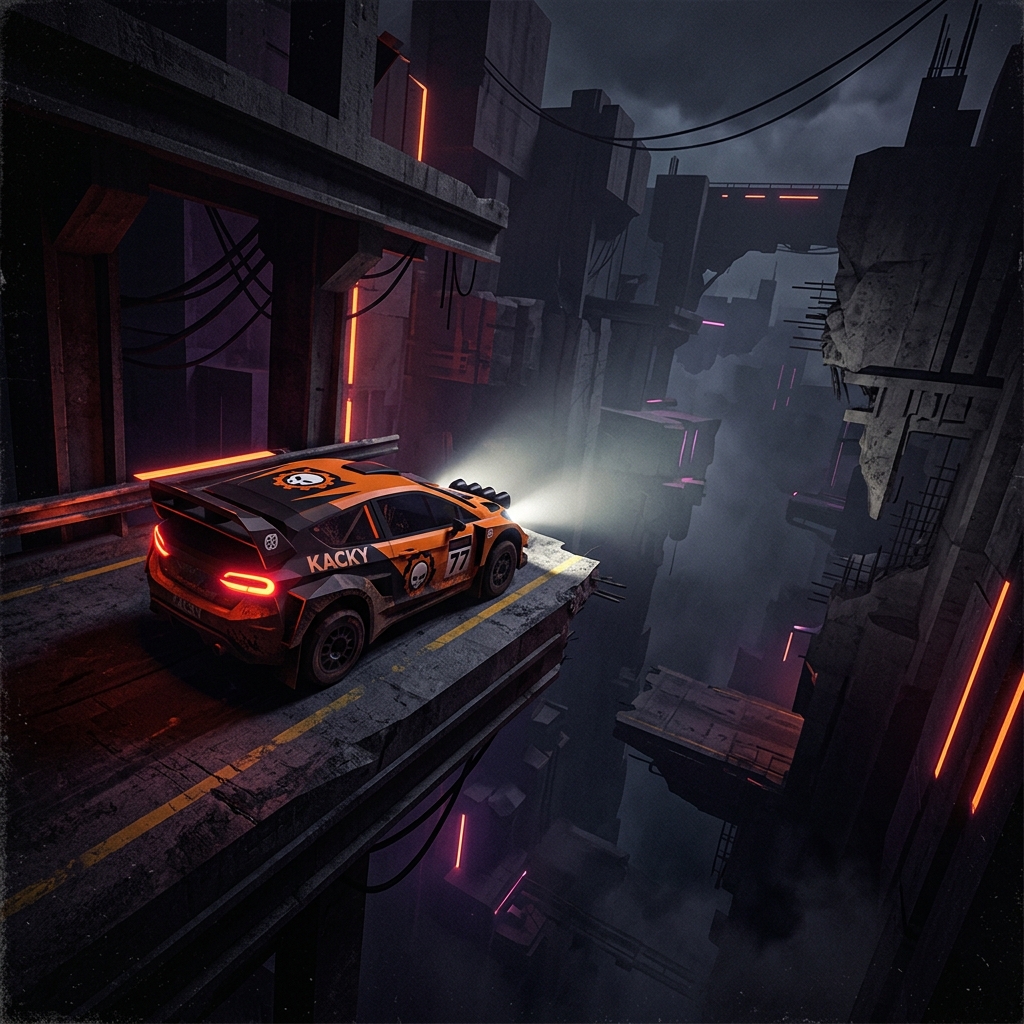
- Community Track #218: Cool Kacky Track — A split-path elevated highway with zero guardrails. Hard difficulty, pure Kacky energy.
- Community Track #174 — Classic Kacky design with deceptive simplicity and precise landing requirements.
- Community Track #58 — One of the earliest Kacky-tagged tracks in the library, featuring vintage PolyTrack physics.
- Community Track #209 — Summer 1 Kacky, a direct tribute to the TrackMania Kackiest Kacky format.
Browse all Expert and Impossible tracks in our Track Library — many carry the Kacky spirit even without the tag.
Why Kacky Matters
Kacky is more than a difficulty label. It represents the creative tension at the heart of PolyTrack's community: the push between accessibility and mastery, between fun and frustration, between "I quit" and "one more try."
The players who grind Kacky maps are not masochists (mostly). They are chasing a specific feeling that no other gaming experience can replicate — the moment when a track that seemed impossible becomes possible, when muscle memory finally aligns with geometry, when the car lands flush on that tiny platform after the hundredth attempt.
That moment is worth every reset.