Track comments are live
PolyTrackCodes now has a comment system on track detail pages. If you are signed in, you can leave a comment directly under a track and share what you learned while racing it.
This is a small change on the surface, but it should make the track library much more useful over time. A track code is only the starting point. The best parts often come from players: the line that saves half a second, the warning about a tricky jump, the setup note for a mobile player, or the quick reaction after finally finishing an impossible section.
You can try it now on any track detail page, including Tokyo Expressway.
Why add comments to track pages?
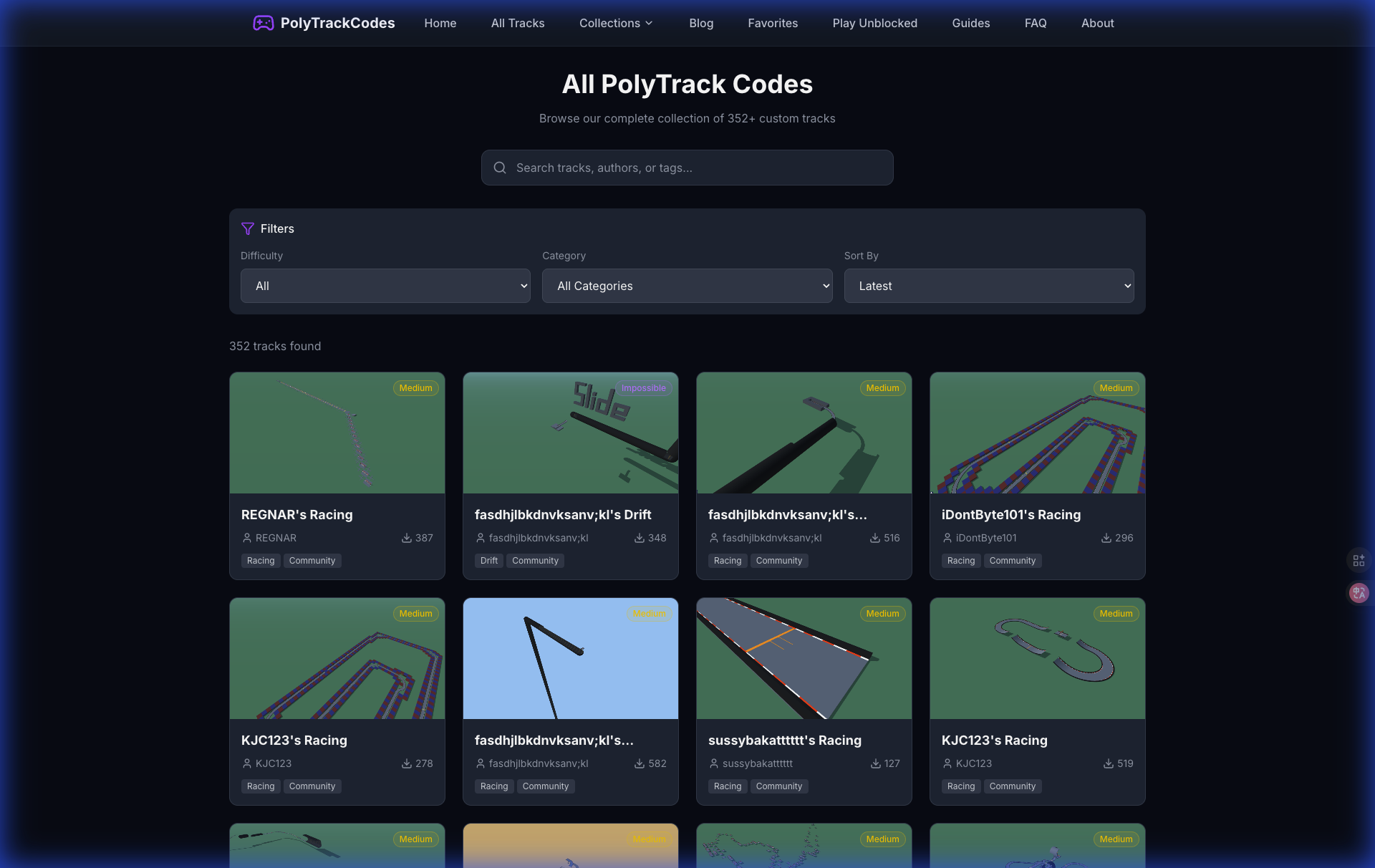
PolyTrack tracks are easier to understand when player context sits next to the code itself. Before this update, a track page could show the title, difficulty, creator, category, and import code, but it could not capture what players discovered after actually driving the track.
Comments give each track page a place for:
- Racing tips and route notes
- Warnings about hard jumps, blind turns, or reset-heavy sections
- Personal-best discussion
- Creator feedback
- Compatibility notes for Chromebook, mobile, or slower devices
- Short reactions from players who completed the track
That matters because PolyTrack is a community game. A great track is not only a layout. It is also the conversation around how to drive it.
Sign in to comment
To keep the system clean, posting requires sign-in. The current login flow uses Clerk, so players can sign in without creating a separate PolyTrackCodes-only password.
Visitors can still browse tracks, copy codes, read existing comments, and use the site normally without signing in. Sign-in is only needed when you want to post a comment.
This gives us a better balance: the site stays open for casual players, while comments have enough identity behind them to reduce spam and low-effort noise.
Comments are reviewed before publishing
New comments are reviewed before they appear publicly. That extra step is intentional.
PolyTrackCodes is a resource for players who want usable track codes and clear information. A comment section should help with that goal, not turn into a mess of spam, off-topic messages, or copied junk. Review lets us keep the useful parts visible while filtering out the rest.
For players, the flow is simple:
- Open a track detail page.
- Sign in.
- Write a comment.
- Submit it.
- After review, approved comments appear publicly on that track page.
If your comment does not appear instantly, that does not mean it failed. It may simply be waiting for review.
What makes a useful track comment?
The best comments are short, specific, and tied to the track. Here are a few examples of comments that help other players:
- "Brake before the second tunnel. If you enter flat out, the exit jump sends you wide."
- "This is easier on keyboard than mobile because the last chicane needs tiny steering corrections."
- "The inside wall after checkpoint 3 can be clipped without resetting if you keep the car level."
- "Great beginner track. The first lap teaches the line clearly, then the second lap rewards speed."
Comments do not need to be long. A single practical note can save another player ten failed attempts.
What comes next
This first version keeps the comment system simple: sign in, post, review, publish. That gives us a stable base before adding more community features.
Possible next steps include:
- Sorting comments by newest or most helpful
- Showing comment counts in track lists
- Letting players report low-quality comments
- Highlighting creator notes
- Adding richer community signals around difficult tracks
We will start with the basics, watch how players use it, and improve from there.
A better home for track knowledge
PolyTrackCodes began as a place to collect and share working PolyTrack codes. With comments, track pages can now become living pages instead of static listings.
If a track has a hidden trick, a better racing line, a frustrating jump, or a route worth celebrating, there is now a place to say it.
Open a track, sign in, and leave the first note for the next racer.