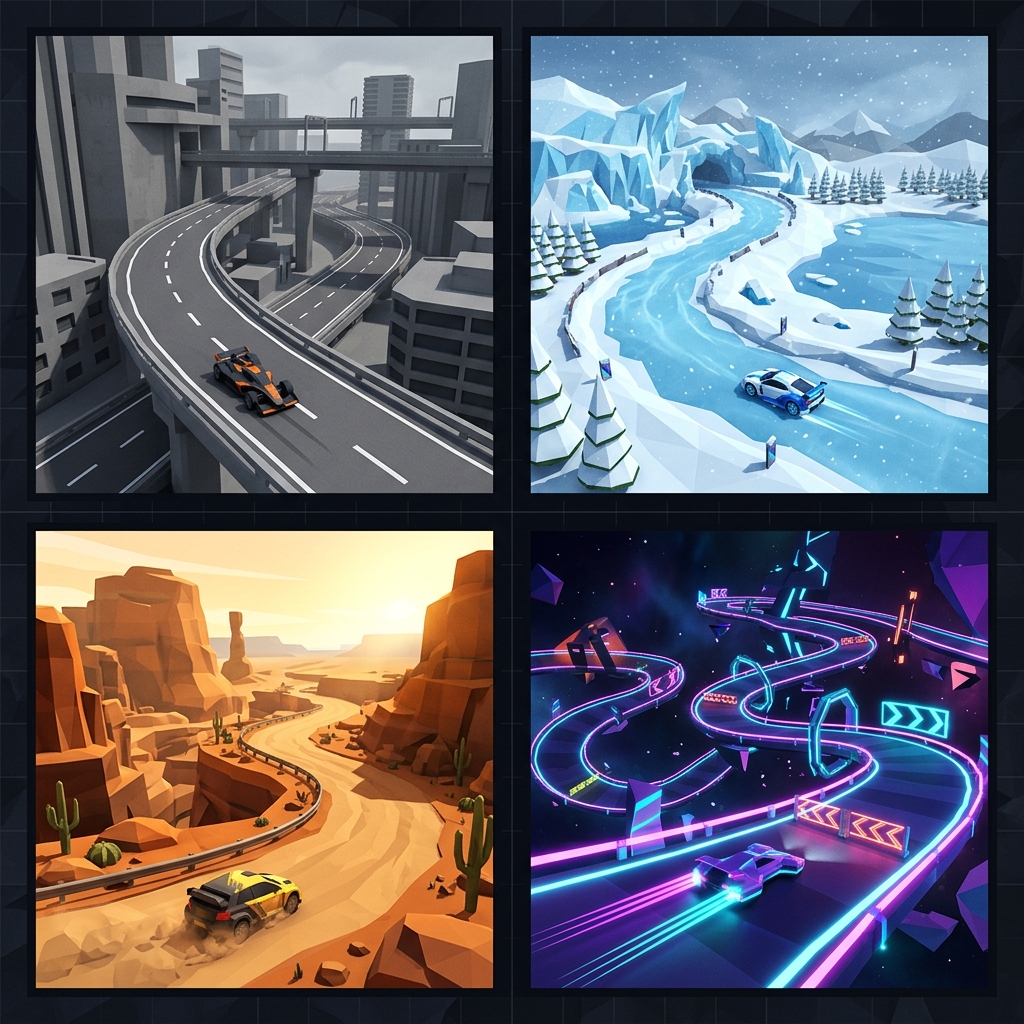
Browse through 100+ community tracks on PolyTrackCodes and a pattern emerges: every creator has a visual signature. Some build cold grey highways. Others sculpt frozen wonderlands. A few wage war against the player through geometry that defies logic.
These are not random aesthetic choices. They are design languages — consistent sets of colors, geometries, and physics assumptions that define how a track looks, feels, and plays. Understanding them makes you a better player (you can read a track's intentions at a glance) and a better creator (you can make deliberate choices about your visual identity).
Here are the 7 dominant design languages in the PolyTrack community.
Visual Signature: Grey concrete, steel columns, sharp 90-degree angles, elevated highways, no decoration.
Brutalist tracks are the most common style in PolyTrack, and for good reason — the game's default palette leans heavily toward grey. But the best Brutalist creators embrace the limitation. Their tracks feel like driving through an unfinished freeway overpass at 3 AM: cold, industrial, and relentless.
Design Characteristics:
- Monochromatic grey road surfaces with minimal color variation
- Elevated structures on thin support columns
- Harsh angular geometry — no curves, just straight segments meeting at sharp angles
- Zero environmental decoration — the track IS the environment
- Shadows used as a design element (dark undersides of elevated sections)
Physics Implications:
Brutalist tracks tend to be technically demanding. The lack of visual cues (no colored markers, no environmental context) means you must memorize the route. The sharp angles create sudden speed changes that punish flowing driving styles.
Notable Tracks in Our Library:
Best For: Players who enjoy precision and route memorization. Creators who prefer function over form.
Visual Signature: Ice blue and white palette, frozen surfaces, crystalline structures, pale sky backgrounds.
Winter tracks transform PolyTrack into a frozen landscape. Creators use the game's ice-surface blocks extensively — not just for aesthetics but for physics. Ice surfaces dramatically reduce tire grip, turning every corner into a sliding puzzle.
Design Characteristics:
- Blue-white-cyan color palette throughout
- Ice surface blocks as primary road material
- Architectural structures suggesting frozen castles or glaciers
- Often paired with tube/tunnel sections (enclosed corridors feel like ice caves)
- Frequently use vertical drops (simulating avalanche routes)
Physics Implications:
Winter tracks play completely differently from standard tracks. The reduced grip on ice surfaces means traditional racing lines do not work — you must initiate slides much earlier and manage understeer constantly. Speed management becomes about momentum, not braking.
Notable Tracks:
Best For: Players who love drifting. Creators who want to build environments with atmosphere and physics variety.
Visual Signature: Recognizable circuit layouts, flat-plane designs, overhead-perspective faithful geometry.
A dedicated subset of creators uses PolyTrack to rebuild real-world racing circuits. These tracks are immediately recognizable to motorsport fans — Monaco's hairpin, the Nürburgring's Carousel, or simplified versions of TrackMania campaign maps.
Design Characteristics:
- Flat or minimal-elevation layouts that mirror real track outlines
- Accurate corner radii based on real-world proportions
- Start/finish placement matching the real circuit
- Tunnel sections where real tracks have underpasses
- Often include pit-lane decorations or spectator areas
Physics Implications:
Recreation tracks tend to play more like traditional racing than the stunt-heavy majority of community tracks. They reward clean racing lines, proper braking points, and consistent speed carry through corners. The driving experience is closer to what you would expect from a proper circuit racer.
Notable Tracks:
Best For: Motorsport fans. Players who want to practice racing fundamentals. Creators who enjoy the challenge of translating real geometry into PolyTrack's block system.
Visual Signature: Floating platforms, impossible gaps, deliberately confusing geometry, visual traps.
Kacky is both a difficulty philosophy and a design language. Kacky tracks look wrong on purpose. Platforms float in the void with no connecting structure. Roads end abruptly at cliff edges. Surfaces are placed at angles that make zero visual sense until you discover the hidden physics exploit that makes them navigable.
Design Characteristics:
- Disconnected geometry — platforms with no visible path between them
- Extreme vertical drops and launches
- Intentionally confusing sightlines (you cannot see the next section until you are committed)
- Minimal road surface — the bare minimum geometry needed to support the car
- Checkpoint gates placed deliberately far apart
Physics Implications:
Kacky tracks are physics puzzles. Every section has a specific speed, angle, and timing requirement that must be met exactly. There is no room for improvisation — the creator designed one specific solution, and your job is to find it.
For a deep dive into Kacky culture and survival strategies, read our dedicated guide: Kacky Tracks Explained.
Best For: Masochists. Players who want the hardest possible challenge. Creators who enjoy watching others suffer.
Visual Signature: Wide road surfaces, gentle curves, long sweeping bends, generous margins.
Flow tracks are designed to feel good. Where Kacky tracks punish, Flow tracks reward. The roads are wide, the curves are gentle, the jumps land on forgiving surfaces. The goal is not survival — it is speed and rhythm.
Design Characteristics:
- Wide road surfaces (2-3x standard width)
- Large radius curves that maintain speed
- Minimal elevation changes — emphasis on horizontal flow
- Often symmetrical or loop-based layouts
- Guard rails or barriers that keep you on track
Physics Implications:
Flow tracks are about racing line optimization. The wide surfaces mean you can always finish the track, but the difference between a good time and a great time lies in finding the perfect line through every corner — cutting apexes, carrying maximum speed, and using the full width of the road.
Notable Tracks:
Best For: Beginners learning fundamentals. Speed addicts chasing flow state. Creators who value polish over punishment.
Visual Signature: Loops, barrels, corkscrews, extreme elevation, structures that go UP more than forward.
Vertical Stunt tracks treat PolyTrack like a roller coaster simulator. The track goes up, inverts, spirals, drops, and launches in ways that prioritize spectacle over practicality. These are the tracks that look incredible in screenshots.
Design Characteristics:
- Heavy use of loop and half-pipe track pieces
- Extreme vertical elevation (tracks that tower above the ground plane)
- Barrel roll sections and inverted road
- Launch ramps into freefall sections
- Spectacular visual impact from any camera angle
Physics Implications:
Vertical tracks demand strong air control skills. Most of your time is spent managing pitch and roll in mid-air, ensuring clean landings on surfaces that might be upside-down relative to your starting position. Speed management at the bottom of loops is critical — too slow and you fall off the ceiling.
Best For: Adrenaline seekers. Screenshot artists. Creators who want to push the visual boundaries of what PolyTrack tracks can look like.
Visual Signature: Warm earth tones, open terrain, rolling hills, sandy textures, mesa formations.
Desert tracks use PolyTrack's terrain blocks to create vast, open landscapes. The track winds through canyons, over dunes, and across plateau mesas. The feeling is distinctly different from the enclosed, architectural style of most tracks — Desert tracks breathe.
Design Characteristics:
- Warm color palette (orange, brown, tan, rust)
- Open sightlines with visible horizon
- Terrain-following roads that undulate with the landscape
- Occasional tunnel sections through "rock formations"
- Sparse decoration — the emptiness is intentional
Physics Implications:
Desert tracks often use elevation subtly — the road surface follows gentle hills, creating blind crests where you cannot see the road ahead until you are committed. This creates a unique memorization challenge: you must learn the elevation profile, not just the 2D layout.
Best For: Players who enjoy exploration. Creators who want to build environments that feel like real places rather than abstract geometry.
The most compelling tracks often combine multiple design languages. A Winter Wonderland track with Kacky Chaos difficulty. A Brutalist highway that transitions into a Vertical Stunt section. A Flow Circuit that winds through a Desert Landscape.
These hybrids create variety within a single run — the player's emotional state shifts as the visual language changes. A calm Flow section lulls you into comfort, then a sudden transition to Kacky Chaos jolts your attention. This pacing is what separates good tracks from great ones.
As a player, identifying a track's design language helps you anticipate what is coming. A Brutalist track will demand memorization. A Flow Circuit will reward racing lines. A Kacky Chaos track will require patience.
As a creator, choosing a design language gives your tracks a consistent identity. Players will start to recognize your work, and consistency builds a following.
Browse our full track library filtered by difficulty and category to discover tracks across every style — or submit your own creation to the community.